
Uber Accident · Lyft Accident
Uber & Lyft Accident Lawyer California: Who Pays?
Rideshare crashes hinge on one thing insurers hope you never check: what the driver app was doing at the moment of impact.
Mihran M. Ghazaryan··7 min read
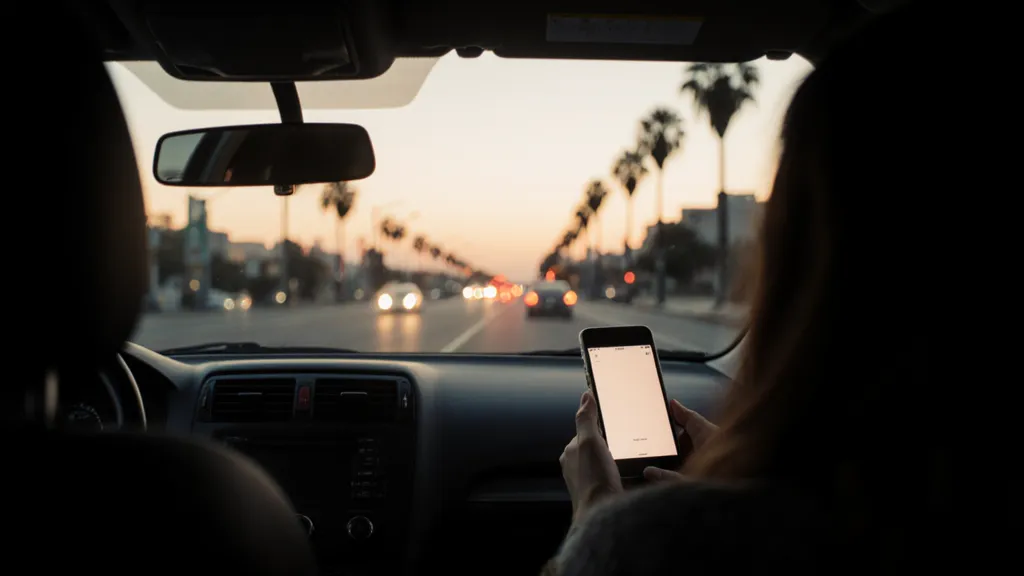
The moment that matters most in a rideshare crash is usually the one nobody thinks about: whether the driver's app was on, and what the screen said when the impact happened. That single detail decides whether you are looking at a $1 million commercial policy or a personal auto policy with California's bare-minimum limits.
If you were hurt in an Uber or Lyft collision anywhere in California, here is how the coverage actually works, who you can pursue, and what to do in the days that follow.
Why Rideshare Crashes Are Harder Than Ordinary Car Accidents
In a standard two-car collision, you deal with one at-fault driver and one insurance company. A rideshare case adds layers: the driver's personal insurer, the transportation network company's (TNC) commercial policy, possibly a third motorist who caused the wreck, and a corporate defendant with a legal team built to argue the driver was an independent contractor.
California classifies Uber and Lyft as transportation network companies, regulated by the California Public Utilities Commission. Under Proposition 22, app-based drivers are generally treated as independent contractors rather than employees, which limits how far you can push a claim that Uber or Lyft is vicariously liable for a driver's negligence. That does not leave you without a remedy — it shifts the fight onto the commercial insurance policy the company is legally required to carry.
The Three Insurance Periods — This Is the Whole Ballgame
California Public Utilities Code sections 5432 and 5433 set the minimum coverage a TNC must maintain, and the amount changes depending on what the driver was doing.
Period 0 — app is off. The driver is using the car personally. Only their own auto policy applies, which in California may be as low as $30,000 per person and $60,000 per accident under the 2025 minimum limits.
Period 1 — app is on, waiting for a ride request. The TNC must carry contingent liability coverage of at least $50,000 per person, $100,000 per accident for bodily injury, and $30,000 for property damage. This coverage sits behind the driver's personal policy, and personal policies routinely exclude commercial use — which is exactly where claims stall.
Periods 2 and 3 — driver has accepted a ride and is en route, or a passenger is in the car. The TNC must carry $1 million in liability coverage, plus $1 million in uninsured and underinsured motorist coverage. That UM/UIM piece is the part most people never hear about, and it matters enormously when the at-fault driver is a hit-and-run or carries almost no insurance.
If you were a passenger, you were almost certainly in Period 3, which means the $1 million policy was live at the moment of the crash. The same is true for pedestrians, cyclists, and other motorists struck by a driver who was mid-trip.
Who Can Actually Recover
The commercial policy is not limited to passengers. People with valid claims after a California rideshare collision include:
- Passengers in the Uber or Lyft vehicle, who are almost never at fault and therefore rarely face comparative negligence arguments
- Drivers and passengers in the other vehicle, when the rideshare driver caused the crash
- Pedestrians and bicyclists struck by a driver on the app
- The rideshare driver, who may have a claim against a negligent third party and, in Periods 2 and 3, access to UM/UIM coverage
- Family members pursuing a wrongful death claim after a fatal collision
California follows pure comparative negligence, so even a plaintiff found partly at fault recovers — the award is simply reduced by their percentage of responsibility.
What to Do After an Uber or Lyft Accident in California
- Get medical attention the same day if you can. Gaps in treatment are the first thing an adjuster uses to argue you were not really hurt.
- Screenshot the trip in the app — driver name, vehicle, trip ID, pickup and drop-off times, and the receipt. This is your proof of which insurance period applied, and app records are not always easy to retrieve later.
- Report the crash through the app, but keep the report factual. Do not speculate about fault or minimize your injuries.
- Call police and get a report number. California requires reporting a crash involving injury or death to the DMV within 10 days on form SR-1.
- Photograph everything — vehicle damage, the intersection, skid marks, your visible injuries — and collect names and numbers for witnesses.
- Do not give a recorded statement to any insurer, including Uber's or Lyft's third-party administrator, before you understand the scope of your injuries.
Be Careful With Early Settlement Offers
Rideshare claims often produce a fast offer, sometimes within days. Those offers arrive before anyone knows whether a soft-tissue injury resolves in six weeks or turns into a surgical case. Once you sign a release, the claim is closed permanently, even if your condition worsens. Our page on how pain and suffering is calculated in California explains what goes into a realistic valuation.
Deadlines You Cannot Miss
In California, the general deadline to file a personal injury lawsuit is two years from the date of the crash under Code of Civil Procedure section 335.1. Property damage claims carry a three-year deadline.
Two important exceptions:
- If a government entity was involved — a city bus, a public works truck, a dangerous roadway condition — you generally must file an administrative claim within six months before you can sue.
- Claims involving an injured minor may have the deadline tolled until the child turns 18.
Insurance policies also impose their own notice requirements that arrive far sooner than any statute of limitations. Deadlines turn on the specific facts of your case, so confirm yours with an attorney rather than relying on a general rule.
What These Claims Are Realistically Worth
There is no formula, and any firm that quotes you a number before reviewing your records is guessing. Value is driven by the severity and permanence of your injuries, total medical expenses (past and future), lost income and reduced earning capacity, and the degree to which your daily life has changed. A sprain that resolves in two months and a cervical fusion are not in the same universe, and the $1 million policy limit is a ceiling, not an expectation.
Frequently Asked Questions
Can you sue Uber for an accident in California?
You can generally bring a claim against the negligent driver and pursue Uber's commercial insurance policy. Suing Uber as a company directly is harder, because Proposition 22 treats drivers as independent contractors — though claims of negligent hiring or app design defects are sometimes pursued. Most cases resolve through the insurance policy rather than against the corporation.
Who is liable in an Uber accident?
Whoever caused the crash. If the rideshare driver was negligent, the applicable TNC policy responds based on the insurance period. If another motorist caused it, you pursue that driver's insurance first — and if their coverage is inadequate, the $1 million UM/UIM coverage in Periods 2 and 3 may fill the gap.
Does Uber's insurance cover passengers?
Yes. When a passenger is in the vehicle, the driver is in Period 3, and the $1 million liability policy applies. Passengers also have the option of pursuing their own auto insurance or a household policy in some circumstances. Our overview of passenger claims in California covers how that works.
What if the Uber driver had the app on but no passenger?
That is Period 1, where the TNC's contingent coverage is limited to $50,000 per person and $100,000 per accident for injuries. These claims often involve a coverage dispute between the driver's personal insurer and the TNC's policy, and they benefit most from early legal involvement.
Do I have to pay anything upfront to hire a lawyer?
For injury cases, no. Our firm handles rideshare claims on a contingency fee — there is no fee unless we recover for you, and the consultation is free.
Talk to a California Rideshare Accident Attorney
Rideshare claims turn on details that are easy to lose: the app status at impact, the trip record, the interplay between two insurers pointing at each other. The sooner those are preserved, the stronger your position.
MMG Law Firm represents injured people across California on a contingency fee basis — you pay nothing unless we win. If you were hurt in an Uber or Lyft collision, contact us for a free, no-obligation consultation, or learn more about our rideshare accident practice.
For official information on TNC regulation in California, see the California Public Utilities Commission. For general guidance on filing a civil claim, see California Courts Self-Help.