
CALIFORNIA PERSONAL INJURY LAW
Medical Bills, Liens, and Treatment Costs After a California Accident
Understand your bills. Know what affects your recovery.
PEOPLE | JUSTICE | RESULTS

A medical bill, an insurance statement, and a lien are different documents.
Clarity before you pay—or settle.
Check the records, identify repayment claims, and understand the amount you may receive.
 Medical billA provider’s request for payment.
 EOBAn insurance explanation, not a bill.
 Lien or repayment claimA claimed right that needs review.
Understand the bills today—and what may come out of a settlement
After an accident, a hospital bill, an insurance statement, and a repayment letter can arrive for the same care. They may describe different obligations. Understanding the difference helps you ask better questions before paying a balance, signing a treatment agreement, or accepting a settlement.
MMG Law Firm offers a free case evaluation for California accident claims. Bring the bills and letters you have; you do not need to sort everything out first.
Call (818) 539-7969 or request a free case evaluation. Phone and video consultations are available. Glendale visits are by appointment.
Four terms that should not be confused
- Medical bill: a provider's request for payment. The billed charge may differ from the adjusted amount, insurance payment, and remaining patient responsibility.
- Explanation of benefits, or EOB: an insurer's explanation of how it processed a claim. It is not itself a bill.
- Lien or reimbursement claim: an asserted right to payment from a recovery, based on a contract, statute, or other legal authority. Not every letter establishes a valid claim for its full stated amount.
- Net recovery: the amount available to the client after applicable fees, case costs, resolved payment obligations, and any necessary reserves. It differs from the headline settlement amount.
Keep each document, including envelopes and deadlines. Matching dates of service and account numbers helps avoid confusing an unpaid provider balance with an insurer's request to recover money it already paid. The CMS guide to checking medical bills explains how to compare records and ask about discrepancies.
Who pays while the accident claim is pending?
Do not assume the other driver's insurer will pay each bill as it arrives. Liability, coverage, and damages may still be disputed. Your treatment funding and your injury claim can follow different timelines.
Depending on eligibility and policy terms, possible payment sources include health insurance, Medicare or Medi-Cal, automobile medical-payments coverage, workers' compensation for a work-related injury, or a provider payment arrangement. Each has its own requirements. Ask about network status, authorizations, deductibles, deadlines, and accident-related reporting.
Do not delay emergency care to discuss billing with a lawyer. For ongoing treatment, discuss medical needs with the treating professional and financial questions with the billing office and insurer. Tell your attorney promptly if cost is interrupting recommended care.
Before you agree to treatment on a lien
Some providers agree to defer collection while an injury claim proceeds. A signed treatment-lien agreement may authorize payment from a recovery, but it does not necessarily make the care free if the case is unsuccessful.
Before signing, ask for written answers:
- What are the charges, and will I receive an itemized statement?
- Can available health coverage be used instead, and what changes if it is not used?
- Do I owe the balance if there is no recovery or an insufficient recovery?
- Are interest, finance charges, collection fees, or other terms involved?
- Who must approve a reduction or release of the obligation?
A provider agreement is separate from MMG's fee agreement. Treatment choices should reflect medical needs; no settlement amount or bill reduction can be guaranteed.
Which repayment claims may affect the case?
Medicare conditional payments
Original Medicare may make conditional payments for accident-related care when another payer may be responsible. Those payments can become subject to recovery after a settlement, judgment, or other payment. Review the claimed services for accident-relatedness, report the resolution, and follow the applicable demand and dispute process. An interim conditional-payment figure is not necessarily the final amount. CMS explains Medicare's recovery process.
Tell counsel about all Medicare coverage, including Medicare Advantage or prescription plans, so potential obligations are identified. Do not assume one letter resolves every payer's rights.
Medi-Cal recovery
California's Department of Health Care Services has a personal-injury recovery process for relevant Medi-Cal payments. Reporting, payment review, and resolution can take time. Identify Medi-Cal involvement early rather than waiting until settlement funds arrive. Review the DHCS personal-injury lien process with counsel and request clarification of the services and amounts claimed.
Private health plans and other insurers
An insurer or health plan may assert reimbursement rights under plan language and applicable law. The type of coverage matters; a self-funded employer plan may raise federal-law issues different from a state-regulated insurance policy. Obtain the plan documents and payment breakdown rather than assuming every claim follows the same rules.
California Civil Code section 3040 addresses certain health-plan and insurer reimbursement liens. Its limits are not a universal formula for every medical lien. Applicability must be reviewed before calculating a reduction.
Providers and hospitals
A signed contractual lien, a hospital's statutory claim, and an ordinary unpaid bill are not interchangeable. Ask what authority supports the demand, what services it covers, what was paid or adjusted, and whether the asserted amount and notice comply with the rules that apply. A document labelled “lien” still needs review.
Check the bill before treating the balance as final
Request an itemized bill and compare it with the EOB and your records. Look for duplicate charges, services you did not receive, incorrect dates, missing insurance payments, or adjustments that were not credited. Ask the billing office to explain discrepancies and keep a written record of the response. CMS provides a practical billing-error checklist.
If you dispute a charge, ask whether collection activity will pause during review and request any agreement in writing. A dispute or pending injury case does not automatically stop every collection deadline. Never ignore a summons or legal notice; obtain advice promptly about the required response.
Some unexpected out-of-network bills may trigger federal or California protections, depending on the coverage and service. These protections do not eliminate every deductible, copayment, or medical debt. Start with CMS medical-bill rights and the California Department of Managed Health Care complaint process for plans it regulates.
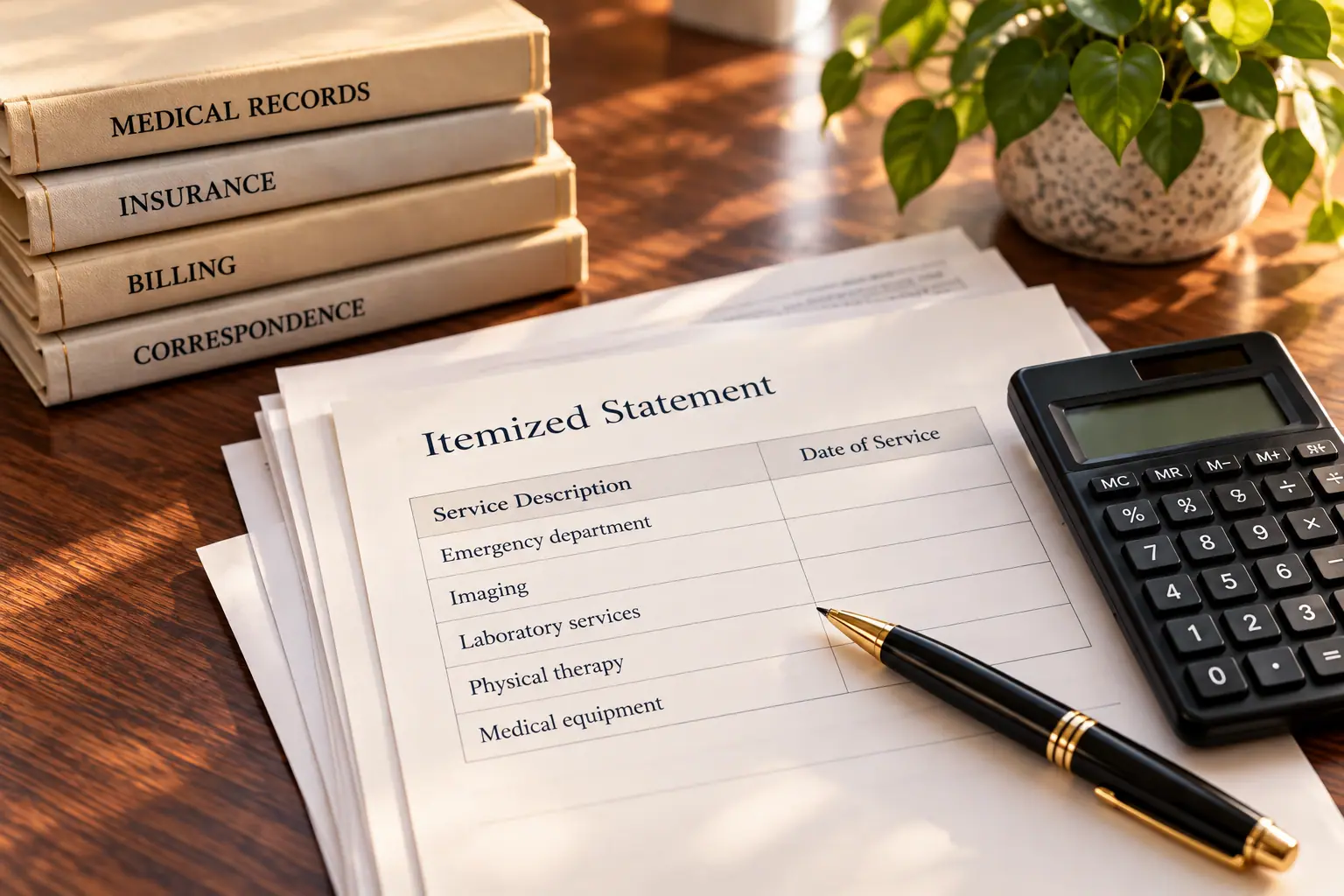
Start with an itemized bill.
- Compare insurance payments.
- Ask about unexplained charges.
- Request financial-assistance policies.
Ask about hospital financial assistance
If a hospital balance is unaffordable, request its charity-care and discounted-payment policies and application. Ask what documents are needed and how a pending accident recovery affects the review. Eligibility is individual; do not assume that either insurance coverage or an accident claim answers the question by itself.
California's Hospital Fair Billing Program provides a hospital-policy lookup and a complaint pathway for financial-assistance issues. Hospital assistance may not resolve separate physician, ambulance, or other provider bills. Keep any written decision and tell counsel about adjustments so the accounting stays accurate.
Why reviewing medical debt matters
The December 2025 Harvard Petrie-Flom commentary Medical Debt is Bad, But Hospitals Make It So Much Worse criticizes hospital collection practices and draws attention to financial assistance and billing problems. It is policy commentary, not a California eligibility rule or a finding about your particular bill.
One underlying North Carolina State Health Plan report describes some nonprofit hospitals recording more than 60%, and even 80%, of bad debt against disadvantaged patients likely eligible for charity care. That is a specific finding about those hospitals, not proof that most California bills are wrong or must be forgiven.
The practical takeaway is to request the records, check the balance, and investigate assistance—not to assume a debt is valid or invalid from a headline.

Medical debt deserves careful review.
Harvard’s Petrie-Flom commentary examines hospital collection practices. California assistance rules require a separate review.
THE SETTLEMENT ACCOUNTING GUIDE
The settlement amount is not the take-home amount.

Gross recovery
Total amount from settlement or verdict.

Fees and case costs
Attorney fees and case expenses.
Resolved payment obligations
Liens, medical bills, and other claims.
Required reserves
Amounts set aside for known or potential obligations.

Estimated distribution
The amount you may receive after applicable deductions and reserves.
Illustration of the accounting process—not a settlement estimate. Reserves may later be paid or released.
Understand the settlement accounting before you decide
Ask for an understandable estimate showing the proposed settlement, attorney fees under the agreement, case expenses, known repayment demands, unpaid bills to be resolved, and amounts still uncertain. A large settlement figure does not tell you what you will receive.
Gross recovery − attorney fees − case expenses − resolved payment obligations − any required reserves = estimated amount available for distribution.
This is an accounting illustration, not a valuation calculator. A reserve for an unresolved obligation is not necessarily a final expense; its later release or payment should be explained. Ask which figures are estimates and obtain written confirmation of agreed reductions or final balances. Avoid subtracting the same obligation twice.
For example, a provider's original charge, its adjusted unpaid balance, and a health plan's repayment demand may be three different numbers. The documents must be reconciled to determine what is actually owed and to whom. Read more about compensation after an accident and how an accident claim works.
What to bring to a consultation
- Provider bills and itemized statements, even if marked past due.
- Insurance cards, EOBs, payment statements, and relevant plan documents.
- Medicare, Medi-Cal, insurer, or recovery-company letters.
- Any treatment-lien or payment agreement you signed.
- Collection notices, court papers, and stated deadlines.
- Receipts, assistance applications, written reductions, and a list of your questions.
Use a secure method arranged with the firm for sensitive records. The initial website message should contain a short overview, not account numbers or detailed medical files.
No. Representation does not automatically pause billing or eliminate third-party obligations. Tell MMG about outstanding balances and notices so the issues can be evaluated within the representation.
No. MMG advances case expenses without an upfront payment. If there is no recovery, no attorney fees or case expenses are owed to MMG. Medical bills, provider agreements, and other third-party obligations are separate. Contingency rates vary by case stage and are explained in the written agreement.
No reduction is guaranteed. The basis of the claim, applicable law, payments, documentation, and case circumstances matter. Ask which amounts can be disputed, adjusted, or negotiated and which remain unresolved.
Not necessarily. The amount billed, amounts paid or incurred, and what can legally be claimed as damages are distinct questions. Do not assume the total printed on a bill equals the amount recoverable from another party.
It can affect timing. Some figures require updated records or formal resolution. Ask what can be distributed, what must be held, and what remains to be completed. Do not rely on a guaranteed payment date before those issues are addressed.
Bring your questions.
Start with a conversation.
A STRONGER
TOMORROW
Get clarity about your accident claim
Whether the injury involved a car, truck, or motorcycle, bring your billing questions into the case discussion early.
Request a free case evaluation · Call (818) 539-7969
MMG Law Firm · 100 W Broadway, Suite 540, Glendale, California. By appointment; phone and video consultations available. An inquiry does not create an attorney-client relationship. This is general information, not individual legal, insurance, or financial advice.
Understand your estimated distribution
Your recovery may be used to pay for known obligations before you receive funds.
- Gross recovery
- Attorney fees
- Case expenses
- Resolved payment obligations
- Required reserves
- Estimated distribution
Reserves may later be paid or released. Ask which figures remain uncertain.
Accounting guide—not a settlement estimate.
Your bill-review checklist
Gather the records. Identify what needs review.
Provider records
Insurance records
Payment agreements
Before settlement
A pending injury claim does not automatically stop billing.