
CALIFORNIA MOTORCYCLE ACCIDENTS
California Left-Turn Motorcycle Accident Lawyer
A turn across your path. A clear look at your options.
Explore the evidence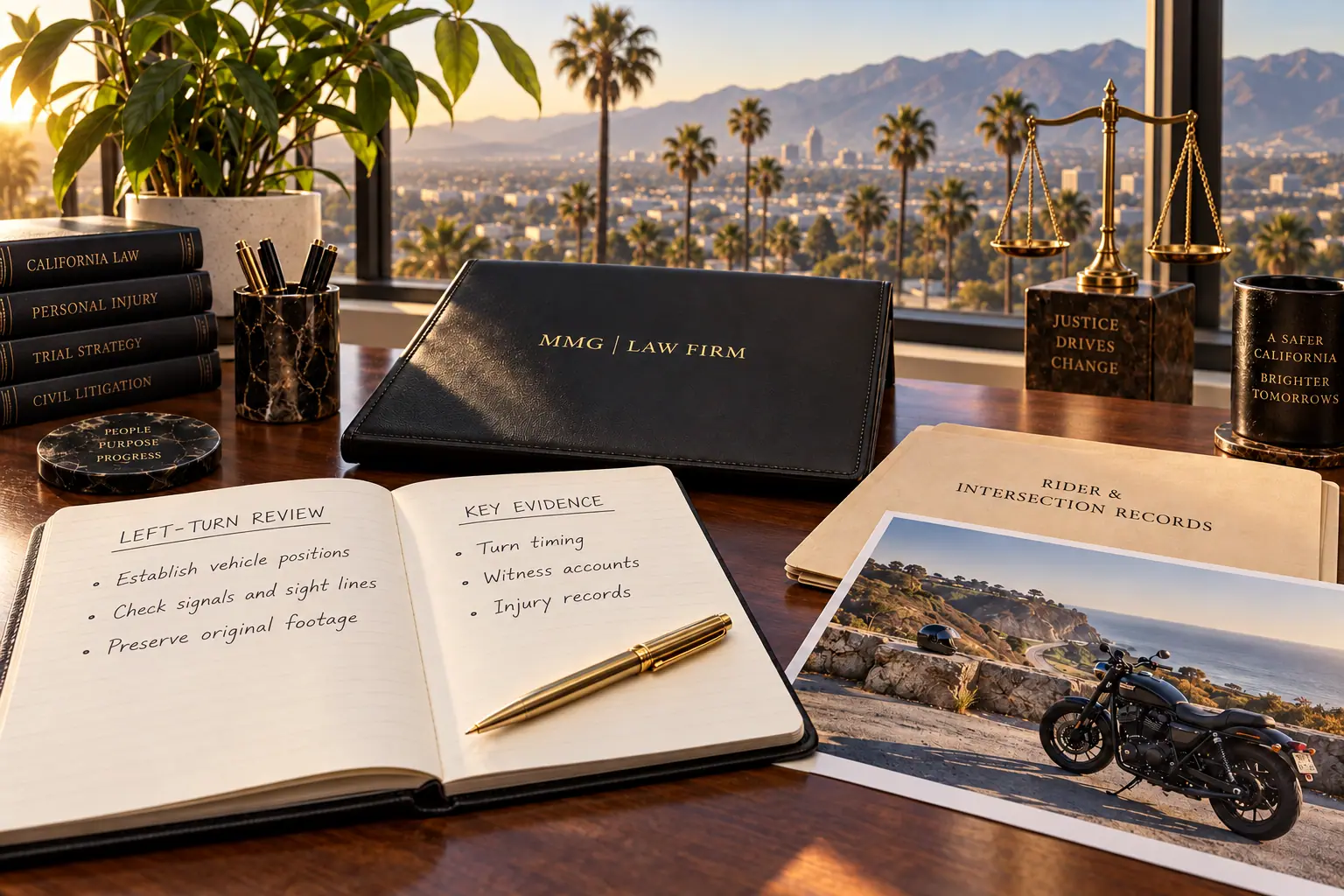
 Visibility & signals
 Injury evidence
The sequence matters.
A left turn alone does not decide fault. Establish where each vehicle was, what each driver could see, and when the turn began.
Who had the right of way?
Timing, approaching hazards, and signals all matter.
What could each person see?
Examine blocked sight lines, lane positions, and original footage.

A driver turned across your path. What happens next?
An approaching car turns left. You brake, swerve, or strike its side. Afterward, the driver says they never saw you—and the insurer starts asking about your speed. A left-turn motorcycle claim should examine the movements of both vehicles, the available sight lines, and the evidence of your injuries.
MMG Law Firm offers free case evaluations for people injured in California motorcycle accidents. You do not need a complete police report or every medical bill before contacting the firm. Call (818) 539-7969 or request a free case evaluation.
If the collision just happened, move out of traffic if you can do so safely, call 911 when emergency help is needed, and seek appropriate medical care. Do not put yourself at risk to photograph the scene.
Four questions that help clarify disputed fault
- Where was the motorcycle when the driver began turning?
- What could each person see, including around stopped vehicles and other obstructions?
- Which signals, signs, and lane markings governed their movements?
- What do independent evidence and witness accounts establish about timing, speed, and opportunities to avoid the crash?
The point of impact is one piece of the sequence. A motorcycle hitting the side of a car does not, by itself, establish who had the right of way.
Let the evidence tell the story.
Preserve original recordings, witness details, and treatment records.
California right of way depends on the sequence
Under California Vehicle Code section 21801, a driver turning left must yield to approaching traffic close enough to create a hazard during the turn and wait until the movement can be made reasonably safely. The statute also addresses what happens after the driver properly yields and signals: approaching drivers must then yield to that turning movement. A left turn alone does not decide liability.
The Judicial Council’s CACI 704 left-turn instruction focuses on whether a reasonably careful person would recognize the danger of a collision. When a turn crosses multiple lanes, hazards in each oncoming lane matter. One driver stopping or waving someone through does not establish that the motorcycle’s lane is clear.
Traffic controls also matter. A protected arrow, a permissive turn, a changing signal, or a driveway entrance can present different factual questions. The investigation should identify the actual control and sequence rather than assume that every intersection follows the same pattern.
Visibility deserves evidence, not assumptions
“I didn’t see the motorcycle” describes a driver’s account; it does not settle whether the driver acted reasonably. The California DMV’s sharing-the-road guidance explains that motorcycles can be harder to see and can disappear in blind spots.
Useful questions include whether a larger vehicle blocked the view, whether the driver looked again before crossing the next lane, and whether lighting or road geometry affected the sight line. Photographs taken later should be identified as later photographs: different traffic, sunlight, parked vehicles, or construction may change what they show.
A rider’s position, headlight condition, clothing, and movements may be investigated when relevant. Those facts require context. Neither a visibility allegation nor a statement that the rider “came out of nowhere” substitutes for reconstructing the approach.
Evidence to preserve promptly
- Original video: Save dashcam, helmet-camera, or other recordings in their original form, with footage from before and after the collision. Keep a backup; avoid editing the only copy.
- Witness information: Preserve names, contact details, and what each person actually observed, including their location and direction of travel.
- Scene details: Keep safe photographs of lane markings, signs, sight obstructions, debris, vehicle positions, and road conditions. Label the date and source.
- Motorcycle and riding equipment: Photograph damage and discuss inspection needs before repair, disposal, or salvage transfer when possible. Coordinate storage and insurer requirements promptly.
- Reports and communications: Keep the incident number, report, insurer letters, messages, and your own factual timeline. Distinguish what you remember from what others later told you.
- Medical and work records: Preserve treatment records, discharge instructions, receipts, restrictions, missed-work records, and notes about changes in daily activities.
Nearby businesses or homes may have useful recordings, but some systems overwrite quickly. Traffic cameras do not necessarily record or retain video. Signal timing plans may help explain operation without proving which light a particular driver faced at the exact moment. Requests should identify the location, date, and relevant time period; access and retention vary.
Injuries and future needs are part of the claim
Liability evidence explains how the crash happened. Medical evidence helps establish which injuries it caused and how those injuries affect your life. Depending on the evidence and applicable law, a claim may include medical expenses, lost earnings, reduced earning capacity, future care, pain and suffering, and property damage.
Describe symptoms accurately to treating professionals and follow their advice. Keep records of limitations such as difficulty standing, returning to work, driving, sleeping, or performing household tasks. Future losses require support; they should not be guessed from an injury label or a website calculator.
Explore compensation available after an accident and catastrophic injury representation. No specific recovery is guaranteed.
How MMG can help you assess the next step
A case evaluation can address the known facts, missing evidence, potential insurance, treatment concerns, and approaching deadlines. If MMG accepts representation, the work can include obtaining records, evaluating conflicting accounts, documenting losses, communicating with insurers, and considering whether additional investigation or litigation is appropriate.
The responsible parties and coverage depend on the circumstances. A driver acting within employment may raise additional questions about an employer. A turning vehicle’s logo or ownership alone does not resolve those questions.
MMG advances case expenses. Contingency rates vary by case stage and are explained in the written agreement. No recovery, no attorney fees or case expenses owed to MMG. Medical bills, liens, and other third-party obligations are separate. See attorney fees and case costs.
No. The turning driver’s duty is important, but timing, signals, the approaching hazard, and both parties’ conduct must be examined. Section 21801 includes duties for approaching traffic after a driver properly yields and begins the turn.
Potentially. A negligent turn may cause a rider to take evasive action and crash without a vehicle-to-vehicle impact. Proving that sequence can be difficult. Liability and uninsured-motorist coverage are separate questions; a no-contact event may raise policy and statutory limitations that require individual review.
Keep the report and identify factual disagreements. A report can contain valuable observations, but the underlying evidence and other accounts still need review. Do not assume that an insurer’s initial decision or an officer’s narrative ends the civil claim.
California personal-injury lawsuits generally have a two-year limitation period, but exceptions and shorter procedures can apply. Claims involving public entities often require a government claim within six months. These are not universal deadlines. The California Courts limitation-period guide and MMG’s accident claim deadlines guide explain why prompt individual review matters. Insurer discussions do not automatically extend a deadline.
Consider whether injuries, future needs, coverage, deductions, and the scope of any release are sufficiently understood. A signed release may end claims it covers. You can seek advice before accepting an offer or signing documents.
Talk with MMG about the turn, the evidence, and your options
Call (818) 539-7969 or request a free case evaluation. Bring what you have: the crash date and location, report number, photographs, witness details, and insurance correspondence are useful starting points.
MMG’s Glendale office is at 100 W Broadway, Suite 540. Visits are by appointment; phone and video consultations are available. You can also explore motorcycle accident representation.
This page provides general information, not advice about a particular claim. Contacting the firm alone does not establish an attorney-client relationship. Imagery is illustrative and does not depict an MMG case.
Let the evidence tell the story.
Preserve original recordings, witness details, and treatment records.
Preserve the evidence
Keep originals. Make a backup.

Some recordings may be overwritten. Request preservation promptly.
CALIFORNIA LEFT TURNS
Who had the right of way?
A turning driver must yield to approaching traffic that presents a hazard.
After properly yielding and signaling, the turning driver may proceed; approaching drivers then have a duty to yield.
The turn sequence matters.
Read Vehicle Code § 21801General information. Facts determine the analysis.