
CALIFORNIA ACCIDENT CLAIMS
California Multi-Vehicle Accident Lawyer
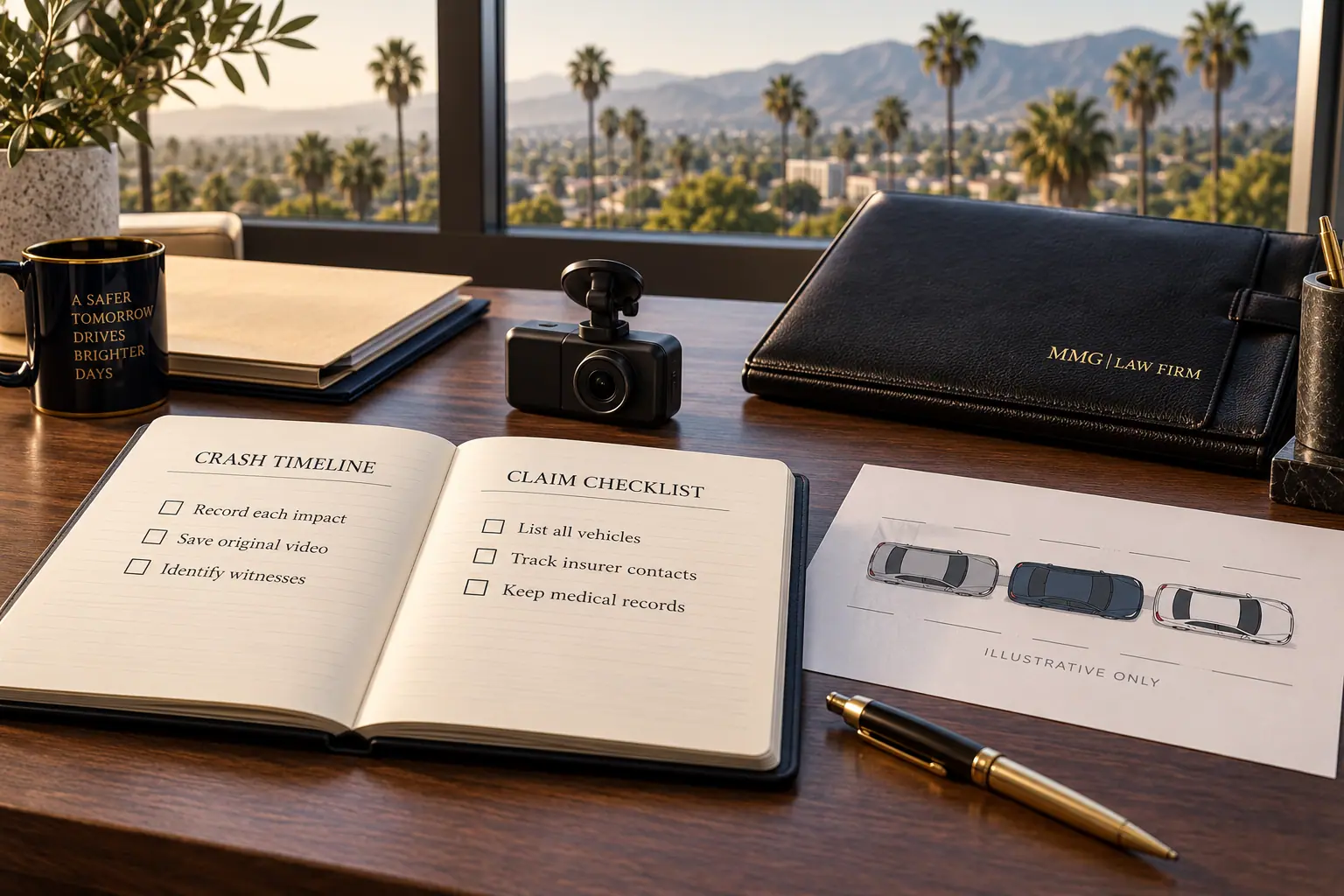
Several impacts. Conflicting accounts. One place to start.
Understand the sequence, the evidence, and your insurance options.

01
Preserve the sequence
Document each impact, capture evidence, and keep original records.

02
Track each claim
Identify all vehicles and insurers involved and monitor each claim.

03
Review every release
Understand how one release may affect your remaining claims.
The order of impacts matters.
Final vehicle positions do not establish who caused each collision.

Reconstruct what happened
Compare video, damage, and witness accounts.

Coordinate the claims
Track each insurer, claim number, and request.

Several impacts. Conflicting accounts. One place to start.
A chain-reaction collision can leave you dealing with injuries, a damaged vehicle, and several insurers pointing toward someone else. You may remember being hit more than once without knowing which driver started the sequence.
MMG Law Firm can review the available evidence, help identify potentially responsible parties, and explain the insurance questions affecting your claim. You do not need to resolve the disagreement between drivers before contacting the firm.
Request a free case evaluation or call (818) 539-7969. No recovery, no attorney fees or case expenses owed to MMG. Medical bills and other third-party obligations are separate.
Who is responsible in a chain-reaction crash?
Responsibility depends on how the collision unfolded and whose conduct contributed to the injuries. The last driver in line is not automatically responsible for every impact. A vehicle’s final position does not, by itself, establish the order of collisions.
An investigation may examine following distance, speed, braking, lane changes, distraction, visibility, roadway conditions, and whether one vehicle was pushed into another. More than one person’s negligence may contribute to the same harm. California’s multiple-cause jury instruction, CACI 431, explains that another contributing cause does not necessarily relieve a negligent defendant of responsibility.
Why the order of impacts matters
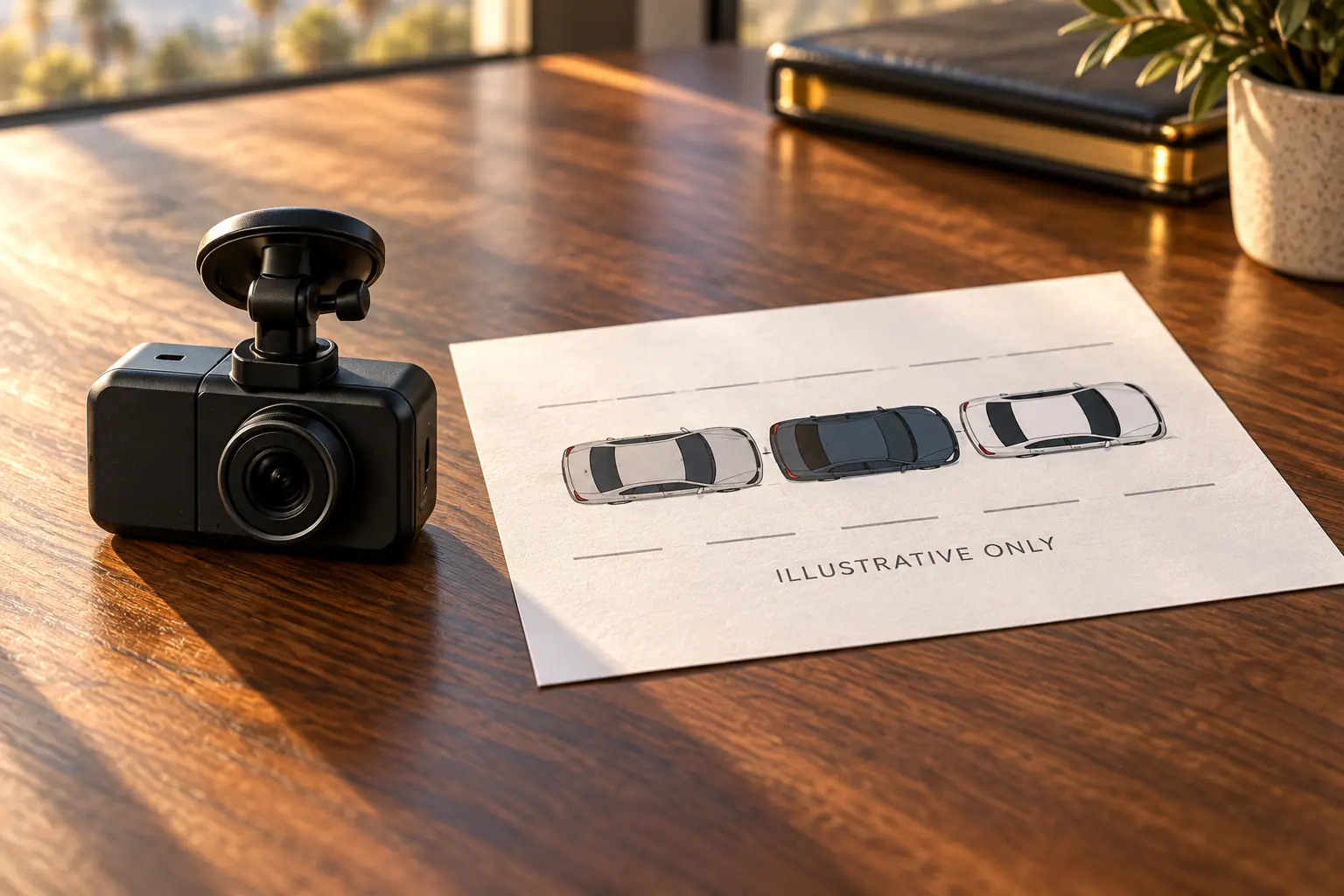
Illustrative example, not an MMG case: Three vehicles are stopped or slowing in a line. If the rear vehicle pushes the middle vehicle into the front vehicle, the investigation differs from a situation in which the middle vehicle strikes first and is then hit from behind. The damage may look similar afterward, but the sequence can affect responsibility and the connection between each impact and the claimed injuries.
That distinction must be supported by evidence. An insurer’s initial diagram or a driver’s confident account is not a substitute for examining the full record.
What injury-severity research can tell us

Drivers
Vehicles

Roadway

Environment

Crash factors
The supplied review excerpt describes how studies were selected. It does not establish fault or predict compensation.
Read research and limitsReconstructing the sequence when accounts conflict
Compare what each person could actually observe
A driver may feel two impacts without seeing what happened behind them. A witness may observe only the final collision. Record what you saw, heard, and felt, and distinguish those observations from what you learned later. Do not guess the number of seconds between impacts if you do not know.
Preserve video and photographs
Original dashcam files and nearby camera footage may help show braking, vehicle movement, and the sequence. Photographs can document damage on every side, debris, road markings, and final positions. Footage may be overwritten, and not every traffic camera records. Identify possible sources promptly without entering traffic or private property to collect evidence.
Review vehicle information in context
Available event data may help specialists examine speed changes or braking around a collision. Vehicle capabilities, recording limits, and the particular event affect what is available. No single download necessarily captures the entire chain reaction. NHTSA explains event data recorders and their short recording windows.
Connect the collision evidence to the injury evidence
Medical records, symptoms reported after the crash, prior health history, and appropriate expert analysis may help evaluate injury causation. A patient should describe their experience accurately rather than assign a diagnosis or a particular injury to one impact without medical support.
Police reports, witness accounts, video, vehicle damage, and medical information can complement or contradict one another. The goal is a supported explanation, not simply a larger stack of records.
What to do while the insurers investigate
- Prioritize safety and treatment. Call 911 for an emergency. Avoid standing between vehicles or entering active traffic to take photographs.
- Identify each vehicle and insurer. Keep driver names, vehicle descriptions, insurance information, and the police report number when available.
- Write down your own recollection. Note whether your vehicle was moving, stopped, or pushed, and what you remember about separate impacts.
- Preserve original files. Save recordings and photos without editing or deleting the originals. Tell counsel if a vehicle may be repaired, sold, or disposed of before an inspection.
- Maintain one claim log. List each insurer, claim number, adjuster, contact date, and requested document. Save letters and messages.
- Report to your insurer promptly. Policy notice and cooperation requirements can apply. Keep your statements factual and say when you do not know an answer.
California DMV requires an SR-1 report within 10 days when a collision causes injury, death, or more than $1,000 in property damage. This is separate from a police report or insurance claim. Check DMV’s SR-1 reporting requirements. See also what to do after a California accident.
How do claims involving several insurers work?
Different policies may address different losses. Each insurer may investigate its insured’s role, coverage, and the extent of your damages. One company accepting a vehicle-repair claim does not necessarily resolve every injury claim.
Liability claims against other drivers
Potential claims depend on responsibility and applicable coverage. With several injured people, an available per-accident limit may have to address competing claims. Multiple vehicles do not guarantee multiple full policy-limit payments.
Coverage under your own policy
Depending on the policy, collision coverage may help with vehicle repairs, medical payments coverage may address qualifying medical expenses, and uninsured or underinsured motorist coverage may be relevant. Deductibles, exclusions, limits, offsets, and settlement conditions can matter. Read MMG’s uninsured and underinsured motorist guide.
Coordination before settlement
Keep track of who paid what. Insurers or health plans may assert reimbursement rights, and payments can affect the remaining claim. Do not assume you can collect twice for the same loss or simply add every policy limit together. The California Department of Insurance coverage guide explains the main coverage types and limits.
If one insurer asks for a statement, clarify whom it represents and why it needs the information. Your obligations to your own insurer can differ from requests by another driver’s insurer. For an overview of claim handling, read the Department of Insurance accident guide.
What if more than one person shares fault?
California allows responsibility to be allocated among people whose negligence contributed to the harm. If your own negligence contributed, it may reduce your recovery rather than necessarily bar it. CACI 406 addresses apportionment of responsibility.
The rules governing how damages are collected from different defendants are more involved than dividing every bill by a single fault percentage. They can depend on the type of damages, the injuries each defendant caused, settlements, and applicable law. Read partial fault in a California accident.
If you were a passenger, potential claims may involve more than one driver, including the driver of the vehicle you occupied. Passengers and drivers do not always have identical legal interests; representation should account for possible conflicts.
What injury-severity research can contribute
The methods excerpt supplied for the linked review of two-vehicle and multi-vehicle crash injury severity describes a structured literature search across transportation and health databases. It groups relevant research around driver characteristics, vehicle attributes, roadway infrastructure, environmental conditions, and crash-related factors.
For someone documenting a collision, those categories offer a useful way to organize questions: What were the vehicles doing? What vehicles were involved? What were the road, lighting, and weather conditions? What happened during each impact? This is a practical application of the categories, not a finding that any one factor caused your injuries.
Research limits: The supplied passage describes search and selection methods, not the review’s results. It does not establish fault, diagnose an injury, rank the causes of your crash, or predict compensation. Injury-severity models describe patterns in study data; individual claims still require case-specific evidence. The full article’s findings have not been independently verified for this draft.
Review every release before resolving part of the case
An offer from one insurer may involve terms affecting claims against other people or available coverage. Review which parties are released, which claims are resolved, whether any rights are reserved, and how liens or reimbursement claims affect the amount you receive.
A property-damage payment and an injury settlement are not automatically the same thing, but the wording of the agreement matters. See insurance settlement offers and releases and medical bills, liens, and treatment costs.
Deadlines continue while fault is disputed
California personal-injury lawsuits generally must be filed within two years, subject to exceptions. Claims involving a government entity commonly require a claim within six months for personal injury, followed by separate lawsuit requirements. Coverage-related deadlines may also apply.
Do not assume that an insurer’s investigation or negotiations extend the time to act. California Courts explains personal-injury filing deadlines. Read California accident claim deadlines and seek advice promptly when a public vehicle or roadway condition may be involved.
No. The sequence, your conduct before the impact, and the evidence matter. Explain what you remember rather than assuming that front-end damage establishes responsibility.
Preserve their written explanations and your supporting records. A legal review can examine the competing accounts and possible coverage while identifying deadlines that continue to run.
Not necessarily. Compensation depends on proven losses, responsibility, available recovery sources, and other case-specific issues. Additional claimants may also compete for limited coverage. See compensation available after an accident.
Yes. Start with the crash date, location, vehicle information, and records you have. You do not need every report or insurer’s decision first.
MMG advances case expenses without an upfront payment. Contingency percentages vary by case stage and are set out in the written agreement. No recovery means no attorney fees or case expenses owed to MMG. Medical bills and third-party obligations are separate. Read attorney fees and case costs.
CALIFORNIA
PEOPLE
JUSTICE
A BRIGHTER TOMORROW
Start with your account of what happened
Request a free case evaluation or call (818) 539-7969. MMG offers phone and video consultations. Visits to 100 W Broadway, Suite 540, Glendale, are by appointment.
General information only; not advice about a specific case. Contacting MMG does not by itself create an attorney-client relationship. Outcomes depend on the facts and applicable law.
Which impact happened first?
Your recollection
Describe what you saw, heard, and felt.
Independent evidence
Compare video, damage, and witness accounts.
Important limit
Final positions alone do not establish the sequence.
A vehicle may have been pushed into another. Responsibility depends on the evidence.
Keep every claim connected.
One place for insurer contacts and requests.
| Insurer | Claim number | Next step |
|---|---|---|
Before signing a release
Review which people and claims it covers, and whether other claims or coverage may be affected.
Multiple policies do not guarantee multiple full-limit payments.
Your multi-vehicle claim checklist
Keep track of what matters from the start.

Do not guess when you are unsure. Preserve original files.