
CALIFORNIA ACCIDENT RESOURCES
Insurance Settlement Offers and Releases in California
Understand the offer. Know what you are signing.
Before-signing checklist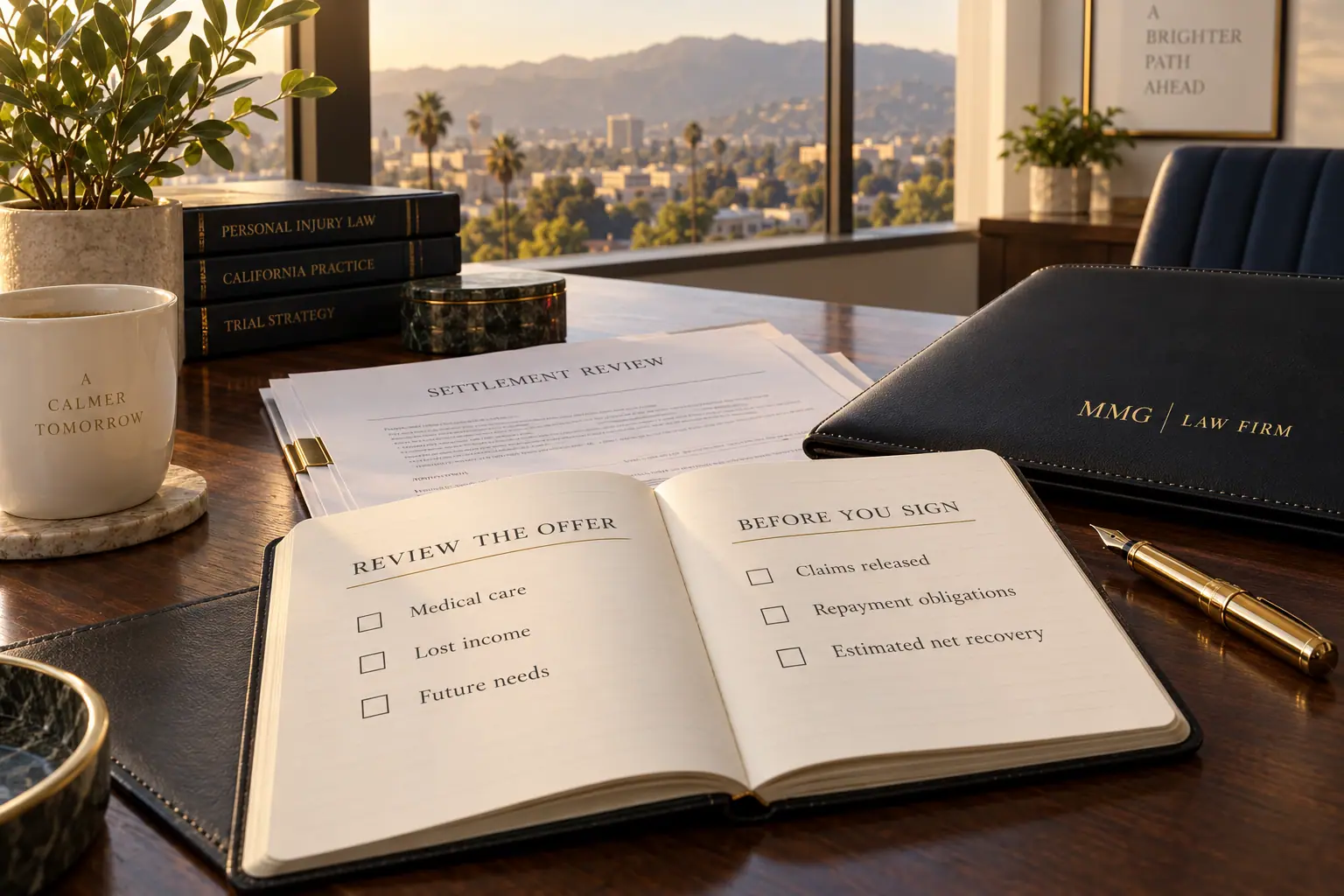

Review the amount
Look beyond today’s bills.

Understand the release
Know which claims will end.

Estimate your net recovery
Factor in liens, repayment obligations, and future care.
Before you accept, understand what ends.
Review the amount, the complete release, and your estimated net recovery together.

What does the offer cover?
An offer may include specific damages, but it may not cover future medical care, lost earning capacity, or other losses.
Which claims will end?
A release can close known and unknown claims, including future treatment related to your injury.
What could you receive?
Your net recovery may be reduced by liens, medical bills, and other repayment obligations.

A signature can close more than today’s bills.
Review future care, unknown-claims waivers, and repayment obligations.

Read the complete release
Understand the full scope of the release, including what rights you may be giving up.
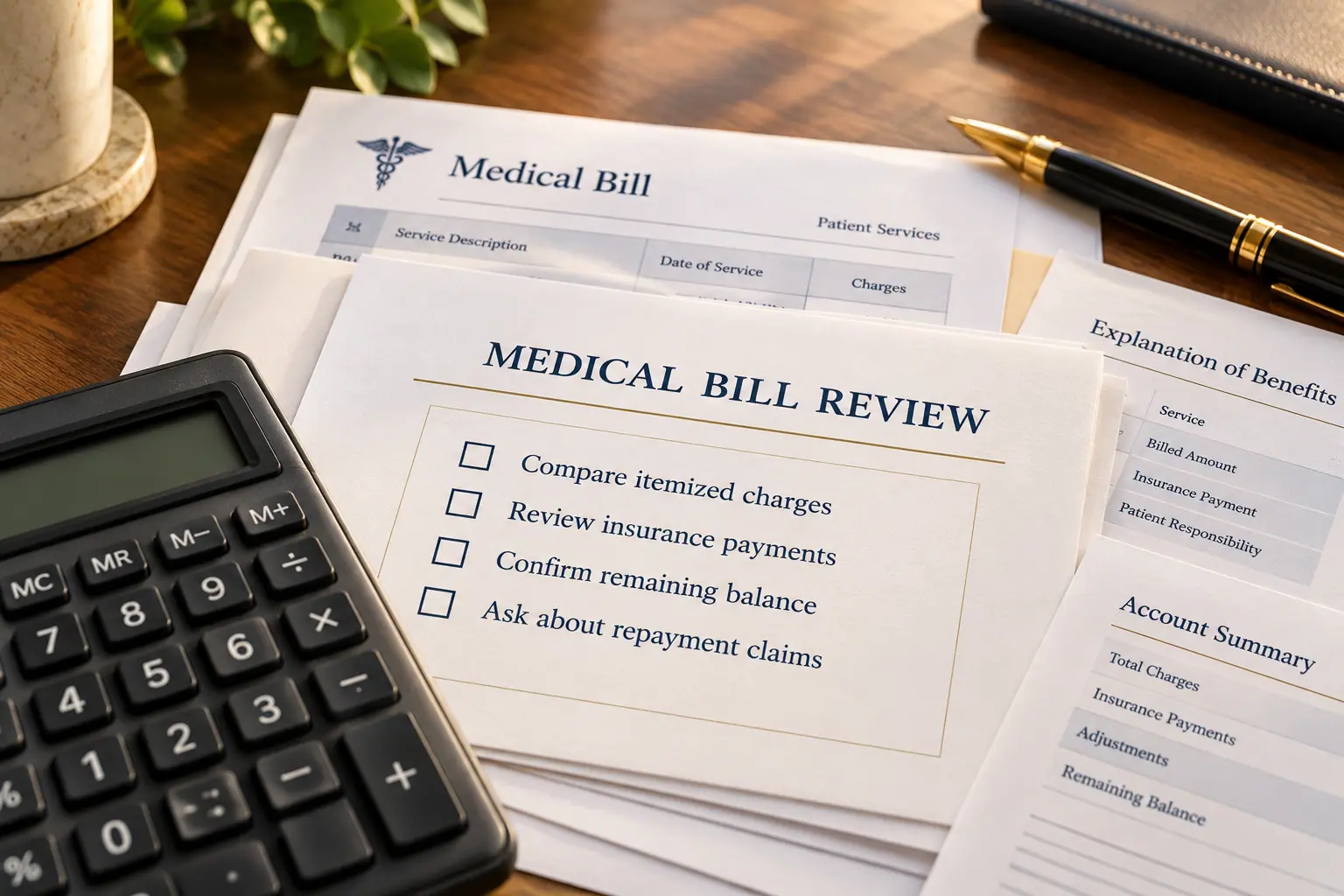
Look beyond the offer amount
Consider liens, medical bills, and other obligations when estimating your net recovery.
Before you accept, understand what ends
A settlement offer can bring needed financial relief after an accident. It can also ask you to give up claims for injuries, future treatment, and losses you do not yet fully understand. Review the amount, the complete release, and your estimated net recovery together.
Have an offer or release in hand? Contact MMG Law Firm at (818) 539-7969 for a free case evaluation. Keep the document and every deadline. You can call even if your records are incomplete.
Your before-signing checklist
- Get the complete offer, proposed release, and any attachments in writing.
- Identify who will be released and precisely which claims will end.
- Review ongoing symptoms, treatment recommendations, and reasonably supported future needs.
- Compare the offer with documented losses, disputed fault, available coverage, and litigation risks.
- Request a written estimate of fees, case costs, repayment obligations, and your net recovery.
- Check whether settlement could affect other claims, including uninsured or underinsured motorist coverage.
- Confirm acceptance deadlines, filing deadlines, payment terms, and any required approvals.
Do not assume you can cancel later. Before replying “I accept,” signing electronically, depositing a settlement check, or returning a release, obtain advice about the proposed terms. Depending on the circumstances, a binding agreement may arise before a formal paper release is signed.
What is the offer actually paying for?
An offer may address vehicle damage, bodily injury, a particular insurance benefit, or several claims together. A payment for repairs does not tell you what a separate injury claim is worth. Equally, a document presented with a vehicle-damage payment may contain broader release language that needs review.
Ask the insurer to identify the coverage, claim, and losses included. Check whether the offer accounts for medical expenses, lost earnings, future care, reduced earning capacity, pain, and limitations on daily life where recoverable and supported by evidence. The amount demanded, the amount billed, and the amount legally recoverable are not necessarily the same.
Read more about compensation available after an accident and how an accident claim works.
Is the offer unreasonably low?
California’s claims-handling regulation prohibits insurers from attempting to settle claims through unreasonably low offers. Under section 2695.7(g), the Insurance Commissioner considers evidence about the insurer’s evaluation, including the claimant’s supporting records, relevant law, adjuster advice, liability, likely outcomes, and property-damage valuation. The regulation also addresses counsel’s advice about exposure above policy limits and distinguishes certain initial and final offers by claimant status.
A disagreement over value alone does not establish a violation. Identify what evidence was overlooked and why it changes the evaluation. Useful questions include: Which medical records were considered? What wage loss was allowed? What evidence supports the proposed fault percentage?
Read the California settlement regulation supplied for this guide, the Cornell reproduction of section 2695.7, and the California Department of Insurance regulation index.
A complaint and a lawsuit serve different purposes
You can seek help through the California Department of Insurance complaint process. A complaint does not guarantee a larger settlement or replace timely legal action.
California’s unfair-insurance-practices statute does not itself create a private damages action under section 790.03. Other remedies depend on the facts and applicable law. Claims involving your own insurer differ from claims against another driver’s insurer; a low offer does not automatically give you a bad-faith lawsuit against that driver’s insurance company. See the California Supreme Court’s Moradi-Shalal decision, hosted by Stanford.
What does the release give up?
A release is a legal agreement ending specified claims against specified people or entities. Read every page, including definitions and attachments. Ask for an explanation of language you do not understand before accepting it.
People and claims covered
Look beyond the named driver. The agreement may refer to employers, vehicle owners, affiliated companies, insurers, or broadly described additional parties. Determine whether claims against another potentially responsible person will survive. Confirm whether the release covers only property damage or also bodily injury and future losses.
Unknown claims and Civil Code section 1542
California Civil Code section 1542 generally protects certain claims unknown or unsuspected when a general release is executed. Settlement documents often expressly waive that protection. A waiver can affect claims involving consequences you discover later; it deserves particular attention when your medical outlook remains uncertain. Read Civil Code section 1542.
Do not assume that a new diagnosis or worsening symptoms will let you reopen an otherwise binding settlement. Whether a release can be challenged is a separate legal question requiring review of the agreement and circumstances.
Promises that continue after payment
Review provisions about liens, reimbursement, indemnity, confidentiality, dismissal of a lawsuit, and payment conditions. An indemnity provision may require you to reimburse or protect another party against specified claims. Ask who bears that risk and whether the wording can be clarified or narrowed.
The offer and your net recovery are different
The settlement amount is the starting figure. Your available proceeds may be affected by attorney fees, case expenses, medical liens, benefit-plan reimbursement claims, and other valid obligations. Some amounts may remain disputed or require a temporary reserve while they are resolved.
Request an itemized written estimate showing:
- Gross settlement and any allocation between claims or recipients.
- The fee percentage and how the agreement applies at the current case stage.
- Case expenses and whether the fee is calculated before or after those expenses.
- Each identified repayment claim, its status, and any negotiated resolution.
- Any reserve, why it is needed, and what must happen before it can be released.
- The estimated amount payable to you, clearly distinguishing estimates from confirmed figures.
At MMG, contingency rates vary by case stage and are explained in the written agreement. MMG advances case expenses without an upfront payment. If there is no recovery, no attorney fees or case expenses are owed to MMG. Medical bills and other third-party obligations are separate. See attorney fees and case costs and medical bills, liens, and treatment costs.
Timing, treatment, and other insurance
If you are still receiving care
Ongoing treatment does not automatically prevent settlement. It does mean that future care and uncertainty deserve careful attention. Discuss your prognosis with treating professionals and the legal effect of a final release with counsel. Do not delay medically necessary care to improve a claim.
If other coverage may apply
Before releasing an at-fault driver, review potential uninsured or underinsured motorist benefits and any policy consent or subrogation requirements. Other insurers may have rights affected by the settlement. Signing first and checking later can create avoidable disputes. Explore uninsured and underinsured motorist claims.
If a deadline is approaching
Ask for any proposed extension in writing, but do not assume it extends a lawsuit deadline. California personal-injury lawsuits generally have a two-year filing period; government claims can involve much earlier requirements, often six months. Exceptions and other deadlines may apply. Negotiations and an insurance complaint do not automatically pause the clock. Consult the California Courts personal-injury guide and our California accident claim deadlines guide.
Accept, counter, or continue the claim?
The decision should reflect the evidence, available recovery sources, release terms, likely time and expense, and your priorities. No universal multiplier or online calculator can resolve all of those questions.
A useful counteroffer connects a requested amount to specific evidence: a treating clinician’s recommendations, documented earnings loss, photographs, witness accounts, or a supported response to disputed fault. Preserve original records and the negotiation history. Avoid guessing, exaggerating losses, or making unsupported threats.
If agreement is not possible, discuss the available next steps and their risks. Litigation may be appropriate in some cases; it does not guarantee a better result. Learn about partial fault in a California accident.
You may seek clarification, negotiate, or decline an offer, subject to the facts and relevant deadlines. There is no rule that every first offer is unfair, or that rejecting it will produce more money. Review its support and terms.
The regulation generally requires insurer payment or performance within 30 days after acceptance and any necessary properly executed release, subject to exceptions. That is not a promise that your net proceeds will reach you within 30 days. Payment conditions, required approvals, funds clearance, and unresolved obligations may affect distribution.
You can request an evaluation. Send the full document, acceptance communications, payment information, and relevant dates. Whether any claim remains or an agreement can be challenged depends on the circumstances. Do not assume a general cooling-off period applies.
Bring the offer, complete release, insurer correspondence, insurance information, medical bills, treatment recommendations, and any lien or reimbursement notices you have. Include the accident date and every stated deadline. Keep sensitive medical or financial records out of a general website message; ask how to provide them securely.
Clarity before commitment.
MMG Law Firm can evaluate the offer, proposed release, and unresolved questions with you.
CALIFORNIA
PEOPLE.
BRIGHTER
TOMORROWS.
Get clarity before you decide
MMG Law Firm can evaluate the offer, proposed release, and unresolved questions with you. Call (818) 539-7969 or request a free case evaluation.
Phone and video consultations are available. Office visits at 100 W Broadway, Suite 540, Glendale, are by appointment only. A consultation request does not by itself establish an attorney-client relationship or extend a deadline.
This guide provides general California legal information. The appropriate decision depends on your circumstances, insurance policies, and proposed agreement.
BEFORE YOU SIGN
Review the release.
Understand which rights the agreement would end.
Do not assume you can cancel after accepting.
UNDERSTAND THE BIGGER PICTURE
Look beyond the offer.
See how different costs can affect your net recovery.
- Gross settlementThe total amount of the offer.
 Attorney feesA percentage of the recovery.
- Case expensesCosts for records, experts, and other case costs.
 Resolved repayment obligationsLiens, medical payments, or other amounts.
 Estimated net recoveryYour potential recovery after costs.
Unresolved obligations may require a temporary reserve.
Ask for an itemized written estimate.

Before you sign.
Use this checklist to review the details of your offer.