
REAL PEOPLE. REAL SUPPORT. A BRIGHTER TOMORROW.
Traumatic Brain Injury After a California Accident
Care comes first. Document the changes that matter.
ANSWERS. GUIDANCE. NEXT STEPS.

Urgent symptoms after a head injury?
Call 911 for seizures, new weakness, increasing confusion, or difficulty waking. Do not wait for a legal consultation.
TBI AFTER AN ACCIDENT
Look beyond the first hospital visit.
Memory, work, daily routines, and support needs may change. Diagnosis and prognosis belong with the care team.
 Medical recordsKeep complete records, including imaging, treatment plans, medications, and provider notes.
 Changes in daily lifeDocument memory, communication, behavior, work or school, and independence.
 Future care needsConsider ongoing therapy, assistance at home, equipment, and long-term support planning.
Medical care comes first
Call 911 or seek emergency care immediately after a head injury if there is a worsening headache that does not go away, repeated vomiting, a seizure, weakness or numbness, slurred speech, increasing confusion, unequal pupils, or difficulty waking. These are examples, not a complete screening checklist. Do not wait for a legal consultation.
Symptoms can appear immediately or emerge hours or days later. If symptoms are new, worsening, or concerning, seek medical advice promptly. Read the CDC's symptoms and danger signs.
When an accident changes how you think, feel, or function
A brain injury can affect more than the first hospital visit. Questions about work, memory, daily support, and future care may arise while the person and family are still trying to understand what happened.
MMG Law Firm can discuss potential representation after a California vehicle accident. A legal review focuses on responsibility, the evidence connecting the injury to the accident, documented losses, available insurance, and deadlines. Healthcare professionals diagnose the injury and guide treatment and prognosis.
Request a free case evaluation or call (818) 539-7969. You can call with the information available now.
What is a traumatic brain injury?
A traumatic brain injury, or TBI, results when external trauma disrupts brain function. A blow, jolt, or penetrating injury can cause it. The diagnosis and its seriousness cannot be determined from vehicle damage or a person's appearance alone.
The NIH's National Institute of Child Health and Human Development explains that TBI ranges from mild injuries, often called concussions, to serious injuries with long-term consequences. A severity label is not a complete description of a person's daily experience or future needs.
After medical evaluation, follow the care team's recommendations about follow-up, work, school, driving, and activity. This page does not diagnose TBI or prescribe a recovery schedule.
Symptoms and lasting effects deserve individual attention
Possible effects include difficulty concentrating or remembering, headaches, dizziness, sleep changes, sensitivity to light or noise, and emotional or behavioral changes. Symptoms overlap with other conditions and require clinical evaluation.
Recovery differs between people. Some improve substantially; others need ongoing rehabilitation, assistance, or accommodations. Avoid assuming either permanent disability or complete recovery from a diagnosis alone. The CDC's recovery guidance emphasizes follow-up and an individualized return to activities.
Useful questions for the care team include: What changes should we monitor? When is urgent reassessment needed? What activities need restrictions? What support or rehabilitation is recommended? Who should coordinate follow-up?

UNDERSTANDING CONSCIOUSNESS AFTER SEVERE TBI
Minimally conscious state
Limited but definite signs of awareness.
A person may show inconsistent but purposeful responses to people, objects, or the environment.
Unresponsive wakefulness syndrome
Wakefulness without observable awareness.
A person may have sleep-wake cycles and open their eyes but show no consistent signs of awareness.
Coma
Unconscious and cannot be awakened.
A person does not respond to voice, touch, or other stimuli.
 Brain death is different: it means the person has died. Qualified clinicians make these determinations.This information is general educational content and not a substitute for medical advice or diagnosis.
Severe TBI: understanding consciousness and responsiveness
NINDS explains that severe TBI can affect awareness, alertness, and responsiveness. Families may hear the following terms. They are not interchangeable and should not be used to diagnose a person from a brief observation.
Minimally conscious state
There are limited but definite signs of awareness of self or surroundings, such as meaningful responses to simple commands. Responses may be inconsistent. Clinical assessment is needed to distinguish awareness from reflex activity.
Unresponsive wakefulness syndrome, or UWS
The person may show wakefulness, such as opening the eyes, without observable evidence of awareness. Movements or reflex responses do not necessarily demonstrate awareness. The treating team should explain how the condition is assessed and followed.
Coma
A person is unconscious, cannot be awakened, and does not show awareness of the surroundings. The course and possible outcomes depend on the injury and other clinical factors; a general timeline cannot predict an individual's recovery.
Read the NINDS traumatic brain injury overview for further background on these terms.
Brain death is different
Brain death means the person has died after permanent loss of function of the brain as a whole, including the brainstem. It is distinct from coma, UWS, and a minimally conscious state. Qualified clinicians use established medical criteria; a single scan or a period of unresponsiveness alone does not establish it. See the 2023 multidisciplinary brain-death determination guideline.
Ask the treating team to explain the diagnosis, findings, uncertainty, and next assessment. Legal counsel cannot determine consciousness, prognosis, or death.
Diagnosis involves more than one piece of evidence
Healthcare providers may consider the injury history, neurological examination, symptoms, and clinically appropriate tests. Imaging can help identify certain injuries, but a normal scan does not by itself rule out every TBI, including concussion. The appropriate tests are a clinical decision.
For a claim, collect the actual reports and records rather than relying on a remembered description of a scan. Prior medical history, the timing of symptoms, and other possible explanations also matter. A lawyer should work from the complete record, including evidence that may complicate the claim.

EVERYDAY DETAILS MATTER
Specific observations can help.
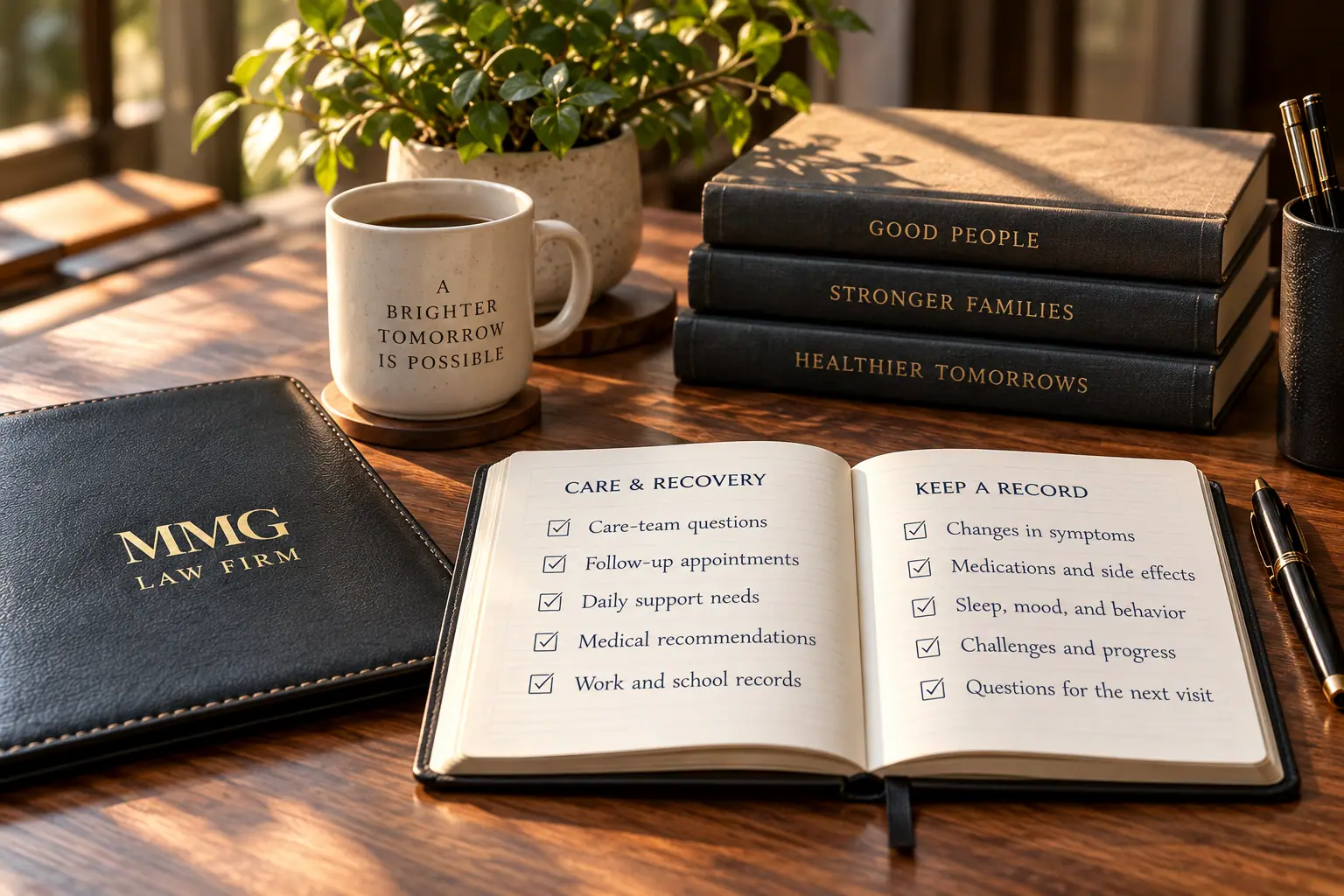
Keep original records. Note daily changes. Follow medical recommendations.
Preserve evidence of the accident and its effects
- How the accident happened: report information, photographs, original video, witness details, vehicle damage, and relevant trip records.
- Early medical care: ambulance, emergency department, hospital, imaging, and discharge records.
- Continuing care: specialist evaluations, rehabilitation records, treatment recommendations, and documented restrictions.
- Daily changes: dated, factual examples of assistance needed, missed activities, and changes noticed by the injured person or family.
- Work or school: attendance, wages, job duties, accommodations, and relevant before-and-after records.
- Insurance and expenses: policy documents, insurer letters, bills, receipts, and benefit statements.
Preserve originals and copies. Record observations honestly without interpreting them as a diagnosis or exaggerating their significance. A diary is supporting information, not a substitute for medical assessment. Do not delay treatment to collect records.
Future care and losses need support
A claim may involve past medical expenses, supported future treatment or assistance, lost income, reduced earning ability, and pain or other legally recoverable losses. Availability and amount depend on liability, causation, evidence, applicable law, and coverage.
Future needs should reflect medical recommendations and the person's functioning. Relevant questions may concern rehabilitation, supervision, transportation, assistive equipment, home support, and the ability to manage work or daily tasks. Specialist evidence or a life-care plan may be appropriate in some cases; neither is automatically required or a guarantee of payment.
Explore MMG's catastrophic injury guide for long-term care considerations. Ask how any proposed settlement accounts for future needs, deductions, and the rights being released before deciding.
When a family member is helping
Family observations may help document changes, and a family member can help organize records or attend a consultation. But being a relative does not automatically authorize someone to access every medical record, sign a fee agreement for another adult, or settle that adult's claim.
If decision-making capacity is in question, discuss the appropriate legal authority and any required court involvement. The care team addresses clinical capacity issues; legal counsel can explain representation and settlement procedures. Do not assume the injured person's condition automatically pauses every deadline.
Insurance and deadlines require a separate review
The seriousness of a brain injury does not establish fault or create unlimited insurance coverage. Review responsible parties, applicable policies, exclusions, limits, and competing claims. Depending on the accident, MMG's UM/UIM guide, hit-and-run guide, or Uber and Lyft guide may help identify questions to ask.
California personal-injury lawsuits commonly have a two-year filing period. Government claims and certain insurance requirements can demand earlier action. Exceptions involving minors or incapacity need individual analysis. See California Courts' personal-injury guidance and government-claim guidance. Ask about deadlines while treatment continues.
FREQUENTLY ASKED QUESTIONS
MORE ANSWERS IN OUR RESOURCESQuestions before contacting MMG
Yes. Evidence, insurance, and deadlines can be discussed while medical evaluation continues. Explain what has and has not been diagnosed. MMG cannot provide a medical diagnosis.
No single result decides the legal question. A claim requires evidence of responsibility, injury, causation, and losses. A clinician should interpret the imaging and symptoms.
They may be relevant if documented and medically evaluated. Specific examples are more useful than broad labels. Other causes and preexisting conditions should also be considered.
There is no reliable diagnosis-only calculator. The person's supported losses, future needs, responsibility, coverage, and other facts matter. Neither a severe diagnosis nor an insurance limit guarantees a particular recovery.
Contingency rates vary by case stage and are explained in the written agreement. MMG advances case expenses without an upfront payment. No recovery means no attorney fees or case expenses owed to MMG. Medical bills, liens, and other third-party obligations are separate.
Let’s talk about your next step.
Compassionate guidance for what comes next.
Talk with MMG about the legal next steps
Request a free case evaluation or call (818) 539-7969. Bring the accident date, available report information, and any urgent insurer correspondence. Avoid sharing sensitive medical details in a general website form.
MMG's Glendale office is at 100 W Broadway, Suite 540. Visits are by appointment; phone and video consultations are available. Meet Mihran M. Ghazaryan or explore car, truck, and motorcycle accident services.
General medical and California legal information, not individual diagnosis or legal advice. An inquiry does not create an attorney-client relationship. See MMG's privacy policy and legal disclosures.
Understanding consciousness after a TBI
After a severe traumatic brain injury, a person’s level of consciousness may change. Here are some terms families often hear.
Minimally conscious state
Limited but definite signs of awareness. A person may show inconsistent but purposeful responses to people, objects, or the environment.

Unresponsive wakefulness syndrome
Wakefulness without observable awareness. A person may have sleep-wake cycles and open their eyes but show no consistent signs of awareness.

Coma
Unconscious and cannot be awakened. A person does not respond to voice, touch, or other stimuli.
Brain death means the person has died.Qualified clinicians determine whether medical criteria are met.Read the NINDS guideYour evidence checklist
Keep a record of what you have. It can help with care and your case.
Accident records

Care and daily life

Work and insurance
Not a diagnostic tool. Do not delay medical care.