
CALIFORNIA MOTORCYCLE ACCIDENTS
California Motorcycle Lane-Change and Blind-Spot Accident Lawyer
An unsafe move. A clear look at your options.
Explore the evidence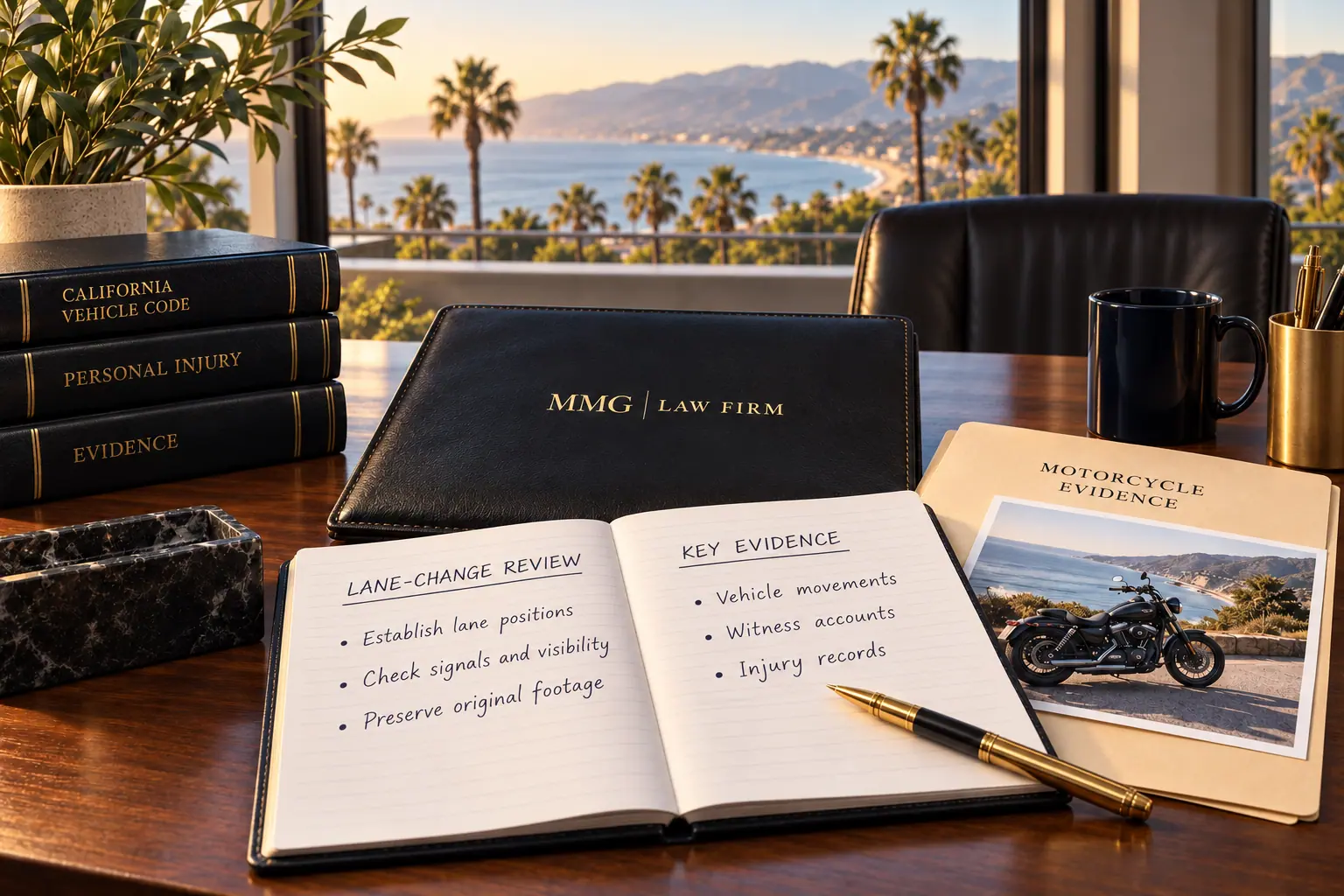


Who moved—and when?
A signal alone does not make a lane change safe. Reconstruct the movements, available space, and what each person could see.
Was the movement safe?
Examine lane positions, signals, speed, and available space.
What does the evidence show?
Preserve original footage, witness accounts, and damage photographs.
A vehicle moved into your lane. Start with the sequence.
A driver drifts across the line, merges into your space, or cuts toward an exit. A sideswipe can knock a rider off balance; an evasive maneuver can cause a crash even without contact. When the accounts conflict, the important questions are where each vehicle was, who moved, and whether that movement could be made safely.
MMG Law Firm offers free case evaluations for people injured in California motorcycle accidents. Call (818) 539-7969 or request a free case evaluation. You can contact the firm before every report or medical bill is ready.
If the crash just happened, get out of immediate danger if you can safely do so, call 911 when emergency help is needed, and seek appropriate medical care. Do not enter traffic to collect evidence.
Let the evidence tell the story.
KEEP ORIGINAL RECORDINGS, PHOTOGRAPHS, AND TREATMENT RECORDS.
What California requires before a lane change
Vehicle Code section 21658 addresses marked lanes: vehicles generally must remain within a single lane and must not leave it until the movement can be made with reasonable safety. Section 22107 separately addresses turning or moving right or left: the movement must be reasonably safe, and an appropriate signal is required when another vehicle may be affected.
A signal communicates an intention; it does not make an occupied space safe to enter. These duties apply to motorcycle riders as well as other drivers. Responsibility depends on the conduct that caused the collision, not simply which vehicle is larger or which person received a citation.
The California DMV’s lane-change guidance tells drivers to signal, examine mirrors and surrounding traffic, check over the shoulder, and ensure sufficient space. Its instructions specifically call for checking blind spots for motorcycles. These practical precautions help frame the investigation; they do not replace an assessment of the particular facts.
Three conflicts that need different evidence
A driver moves into a rider’s occupied lane
The investigation should establish the motorcycle’s position before the vehicle crossed the line. Relevant details include turn-signal timing, traffic speed, lateral movement, and what the driver could have observed. Contact damage may help test the accounts, but damage alone may not reconstruct the whole event.
Two vehicles move toward the same gap
When both vehicles are changing lanes, the first task is to establish their paths and timing. Which lane did each start in? Was either already established in the destination lane? Could either person reasonably recognize and respond to the other’s movement? Avoid assuming that the person who signaled first automatically had priority.
A merge, lane ending, or last-minute exit creates a conflict
Preserve the signs, taper, lane markings, and road configuration. An entrance ramp, ending travel lane, construction diversion, and driveway entry can raise different questions. The analysis should identify the actual maneuver rather than apply a blanket “merging vehicle always loses” rule.
A blind-spot explanation is a starting point
“I never saw the motorcycle” does not resolve whether the driver used reasonable care. The DMV’s motorcycle-sharing guidance explains that motorcycles are smaller and can disappear in vehicle blind spots, and tells drivers to check for them when changing lanes or entering a road.
Useful questions include the vehicle’s size and mirror arrangement, the motorcycle’s position over time, visibility obstructions, and whether the driver checked before moving. A later photograph may show the roadway without reproducing the traffic or lighting at the time of the crash. Label when it was taken.
A blind-spot monitor also does not settle the issue. Do not assume the vehicle had one, that it would detect every motorcycle, or that it retained useful records. Equipment, operating conditions, and available data must be identified before drawing conclusions.
Evidence to preserve promptly
- Original video: Keep helmet-camera, dashcam, and other recordings, including the approach and aftermath. Back up originals; do not edit the only copy.
- Independent witnesses: Save contact information and each witness’s viewing position. Someone behind the vehicles may have seen lane movement that another witness missed.
- Roadway photographs: When safe, document lane boundaries, merging signs, obstructions, construction, debris, and final vehicle positions.
- Damage and equipment: Photograph both sides of the motorcycle and damaged riding equipment. Discuss inspection needs before repair, disposal, or salvage transfer where possible; address storage requirements promptly.
- Reports and communications: Keep the incident number, report, insurer correspondence, and a factual account of what you remember. Separate personal observations from information learned afterward.
- Injury and income records: Save treatment instructions, bills, receipts, work restrictions, missed-work documentation, and notes about daily limitations.
Nearby recordings may be overwritten quickly. A preservation request should identify the date, location, time period, and material sought, but it does not guarantee that footage exists or will be provided voluntarily. Not every traffic camera records. Electronic vehicle data may help in some cases, but availability varies and it may not establish a lane change by itself.
Injury evidence and potential compensation
Documenting an unsafe movement is only part of a claim. Medical and other evidence must also connect the collision to the injuries and losses claimed. Depending on the facts and applicable law, compensation may include medical expenses, lost income, diminished earning capacity, future care, pain and suffering, and property damage.
Report symptoms accurately to treating professionals and follow their advice. Keep track of changes in mobility, sleep, work, and ordinary activities without guessing at diagnoses or future costs. Lasting limitations may require medical opinions and additional documentation.
Explore compensation available after an accident and catastrophic injury representation. No particular outcome is guaranteed.
How MMG can help clarify your options
A consultation can address the crash sequence, evidence gaps, insurance questions, treatment concerns, and time limits. If MMG accepts representation, the work can include gathering records, evaluating disputed accounts, documenting losses, communicating with insurers, and assessing whether further investigation or litigation is appropriate.
When a commercial vehicle is involved, the driver’s work activity and business relationships may also matter. A company logo alone does not establish employer responsibility or coverage. Each potential claim requires factual support.
MMG advances case expenses. Contingency rates vary by case stage and are explained in the written agreement. No recovery, no attorney fees or case expenses owed to MMG. Medical bills, liens, and other third-party obligations are separate. Review attorney fees and case costs.
Potentially. An unsafe movement may cause a rider to brake or swerve and crash without contact. Evidence connecting that movement to the crash is important. A claim against an identified driver and uninsured-motorist coverage present separate questions; a no-contact event can raise coverage restrictions requiring individual review.
No. Signaling does not replace the requirement that the movement be reasonably safe. Its timing and visibility are evidence to evaluate alongside positions, speed, and available space.
Preserve the report and explain specific factual disagreements. Independent recordings, witnesses, and physical evidence may help evaluate the conclusion. Neither an initial insurance decision nor a report’s narrative substitutes for examining the underlying facts.
California personal-injury lawsuits usually must be filed within two years, but exceptions and shorter procedures can apply. Claims involving public entities may require an initial government claim within six months. Do not use these general periods to calculate your own deadline. See California Courts’ personal-injury guide, the court guidance on government claims, and MMG’s accident claim deadlines guide. Insurer discussions do not automatically extend filing deadlines.
No. The date, location, basic account, insurer information, and any available photographs or report number are a useful start. Tell the firm if evidence may be overwritten or the motorcycle is awaiting repair or salvage transfer.
Take the next step with what you have
Request a free case evaluation or call (818) 539-7969. MMG’s Glendale office is at 100 W Broadway, Suite 540. Office visits are by appointment; phone and video consultations are available.
For related guidance, see motorcycle accident representation and left-turn motorcycle accidents.
General information, not advice about an individual claim. Contact alone does not establish an attorney-client relationship. Imagery is illustrative and does not depict an MMG case.
Let the evidence tell the story.
KEEP ORIGINAL RECORDINGS, PHOTOGRAPHS, AND TREATMENT RECORDS.
Preserve the evidence
Keep originals. Make a backup.

Recordings may be overwritten. Act promptly.
Was the lane change safe?
A driver must not leave a marked lane until the movement can be made with reasonable safety.
A signal communicates intent. It does not make an occupied space safe to enter.
- 1Establish starting positions
- 2Check signals and available space
- 3Compare both vehicle movements
General information. Facts determine responsibility.