
CALIFORNIA MOTORCYCLE ACCIDENTS
California Motorcycle Passenger Injury Claims
You were the passenger. Your options deserve their own review.
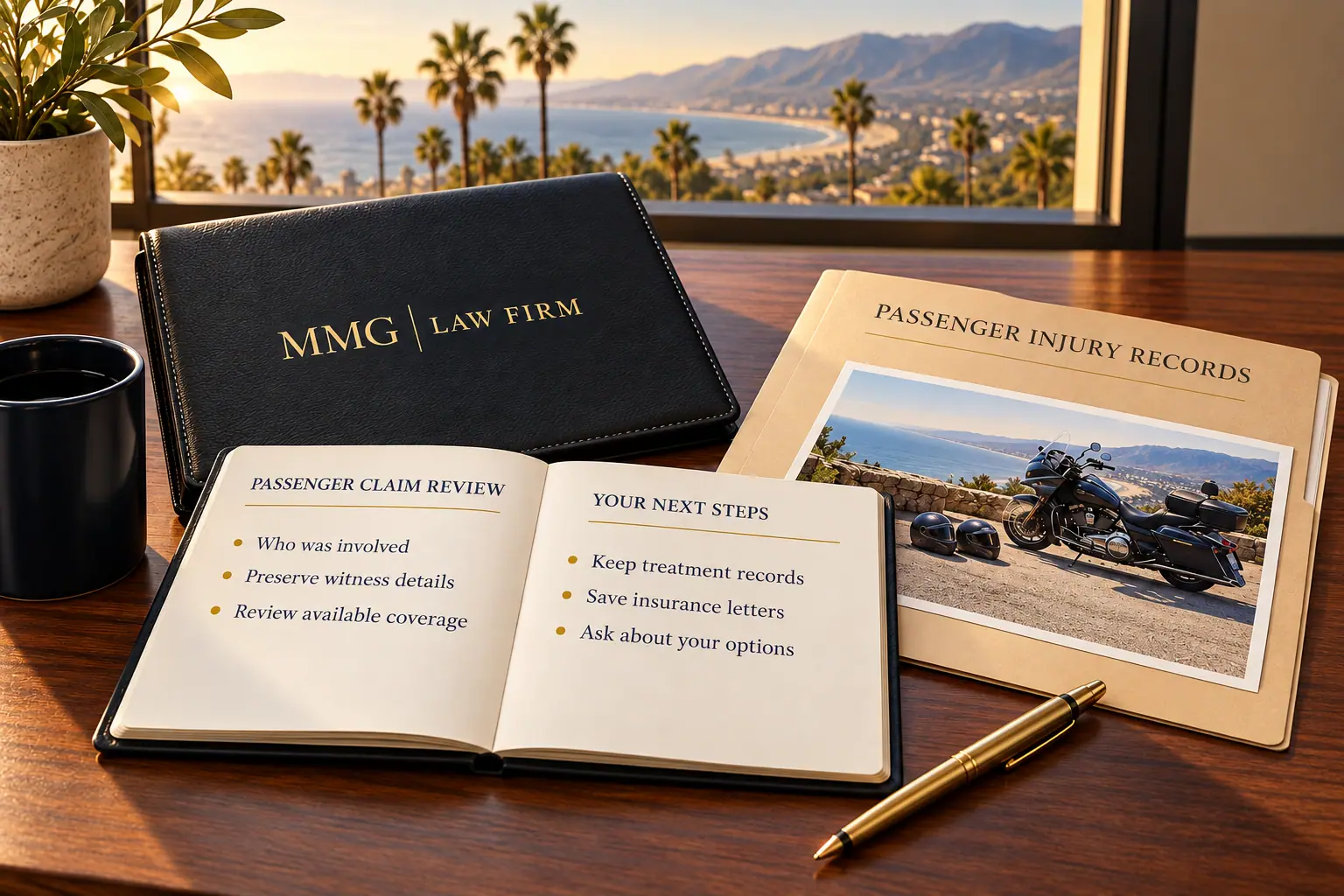
Your claim deserves its own review.
The operator, another driver, or more than one party may be responsible. The facts and available coverage matter.
Who may be responsible?
Examine each person’s role in causing the crash.
Which insurance may respond?
Review policies, exclusions, and available limits.
You were the passenger. Your injuries deserve their own review.
After a motorcycle crash, you may be facing treatment bills, missed work, and uncertainty about whose insurance should respond. You may also worry about making a claim when the operator is a friend, partner, or family member. Your options depend on what caused the crash, who may be legally responsible, and what coverage applies—not simply whose motorcycle you were riding.
MMG Law Firm offers free case evaluations for injured California motorcycle passengers. Call (818) 539-7969 or request a free case evaluation. You do not need to decide who was at fault before calling.
If the crash just happened, seek emergency assistance when needed and prioritize medical care. Do not put yourself in traffic to photograph the scene or retrieve property.
Understand your options before deciding.
Bring the facts, insurance letters, and treatment records you have.
Who may be responsible for a passenger’s injuries?
Another driver
A driver who turns across the motorcycle’s path, changes lanes unsafely, follows too closely, or otherwise drives negligently may be responsible if that conduct causes your injuries. The Judicial Council’s CACI 700 instruction explains drivers’ basic duty to use reasonable care, maintain a lookout, and control their vehicles.
The motorcycle operator
The person carrying you may also bear responsibility if their negligent operation caused or contributed to the crash. Riding with someone you know does not, by itself, eliminate a potential claim. A crash alone does not prove operator negligence; the movements, conditions, and available evidence need review.
More than one party
Both the operator and another driver may have contributed. Other circumstances may justify investigating a vehicle owner, an employer, a repair business, a defective component, or a dangerous roadway condition. Each theory requires its own facts and legal basis. Ownership, employment, or involvement alone does not establish liability.
You do not have to pick one version of events while injured and still gathering information. Preserve what you know and identify what you did not see.
If the operator is someone close to you
It is understandable to want medical expenses addressed without harming a relationship. A consultation can explain potential claims, applicable insurance, and the decisions involved before you choose how to proceed.
An insurance claim may be resolved without a lawsuit, but that cannot be promised. Nor can anyone promise that the operator will face no personal exposure, premium consequences, or other effects. Coverage and available limits must be checked rather than assumed.
Your interests and the operator’s interests may differ, especially when fault is disputed or insurance funds are limited. A lawyer must evaluate conflicts before representing both people. A shared ride does not necessarily mean shared representation is appropriate.
Which insurance may respond?
The California Department of Insurance consumer guide explains liability, uninsured/underinsured motorist, and medical-payments coverage. These are different types of protection. The guide provides background; it does not establish that a particular motorcycle passenger is covered.
- Liability coverage: Review policies that may insure a legally responsible driver or operator. Who is insured, exclusions, and limits matter.
- Uninsured or underinsured motorist coverage: Potential coverage under the motorcycle policy or another qualifying policy requires review of insured status, policy terms, statutory requirements, and any coverage rejection. It is not automatic.
- Medical-payments coverage: If purchased and applicable, it may help with covered medical expenses without deciding fault, subject to its terms and limits.
- Health coverage: It may help pay for treatment, but deductibles and potential reimbursement claims need separate attention.
Obtain declaration pages, policy information, and insurer letters where available. When multiple people are injured, a per-accident limit may be shared; do not assume each person can recover the full listed limit. Multiple policies also do not mean their limits can simply be added together.
Before accepting a settlement or signing a release, understand which parties and claims it covers and whether it could affect remaining insurance options. Related guides: uninsured and underinsured motorist claims and medical bills, liens, and treatment costs.
Evidence to preserve promptly
- Names and contact details for the operator, other drivers, and independent witnesses.
- Police report information and original photographs or video from before and after the crash.
- Insurance cards, policy details, claim numbers, and correspondence.
- Photographs of the motorcycle, passenger seat, footrests, helmet, and other damaged equipment.
- Medical records, treatment instructions, bills, receipts, and work restrictions.
- Your own factual account of seating position, what you observed, and what happened next.
Keep originals and backups. Do not fill gaps in memory with guesses or adopt someone else’s account as your own. Discuss inspection needs before disposal or repair of important equipment where possible, while addressing storage and insurer requirements promptly. Nearby video may be overwritten; a request does not guarantee footage exists or will be provided.
Passenger safety and disputed fault
Being a passenger does not automatically make you responsible for the operator’s driving. However, your own conduct may be examined. CACI 711 explains that passengers may generally expect reasonable care from a driver, but must take reasonable steps for their own safety when they become aware of danger or impaired or careless driving. What was known and reasonably possible matters.
California Vehicle Code section 27800 addresses passenger seating and footrests. Section 27803 requires compliant safety helmets for motorcycle operators and passengers. Equipment and helmet questions should be evaluated with the actual circumstances and injury evidence.
A missing helmet does not automatically resolve every aspect of a claim. The legal effect depends on the applicable rules and evidence connecting the conduct to the injuries at issue. Do not assume that an allegation ends your case. See partial fault in a California accident.
Document the effect on your life
Depending on the evidence and applicable law, a passenger’s claim may include medical expenses, lost earnings, reduced earning capacity, future care, and pain and suffering. Preserve information about limitations in work, mobility, sleep, household activities, and independence.
Report symptoms accurately to treating professionals and follow their advice. Future losses require supporting evidence; neither the seriousness of a crash nor a website calculator establishes their value. See compensation available after an accident and catastrophic injury representation.
Potentially. The investigation may consider operator conduct, road conditions, mechanical issues, or another vehicle’s actions even without contact. A single-vehicle crash does not establish either that no claim exists or that the operator must be liable.
Your injuries and potential claims still need independent review. Preserve both parties’ information and let evidence establish their roles. You need not resolve the dispute before seeking advice.
It can affect policy analysis. The identity of the insured, passenger status, household relationships, exclusions, and applicable law should be reviewed together. Neither automatic coverage nor automatic exclusion should be assumed.
California personal-injury lawsuits generally have a two-year deadline, but exceptions and shorter claim procedures may apply. Public-entity involvement can require an earlier government claim. The California Courts personal-injury guide explains the general deadline. Get individual advice promptly; insurance negotiations do not automatically extend it. See California accident claim deadlines.
A child’s claim involves additional representation and settlement procedures. Do not assume every deadline waits until adulthood, particularly where a public entity is involved. Tell the attorney the child’s age and whether any offer or release has already been received.
Talk with MMG about your own options
A free evaluation can address the known facts, responsible parties to investigate, potential insurance, evidence needs, and time limits. If MMG accepts representation, the work may include obtaining records, evaluating competing accounts, documenting losses, and pursuing an appropriate resolution. Outcomes cannot be guaranteed.
MMG advances case expenses. Contingency rates vary by case stage and are explained in the written agreement. No recovery, no attorney fees or case expenses owed to MMG. Medical bills, liens, and other third-party obligations are separate. Read attorney fees and case costs.
Call (818) 539-7969 or request a free case evaluation. MMG’s Glendale office is at 100 W Broadway, Suite 540. Visits are by appointment; phone and video consultations are available. Explore motorcycle accident representation for related guidance.
General information, not individual legal advice. Contact alone does not create an attorney-client relationship. Images are illustrative and do not depict an MMG case.
Who may be responsible?
Another driver
Conduct that caused or contributed to the crash.
The motorcycle operator
Operator negligence requires factual support.
More than one party
Each potential claim needs its own legal basis.

Being a passenger does not decide fault or guarantee recovery.
Which insurance may respond?
Review coverage before assuming it applies.

Liability coverage
May apply when another driver or the motorcycle operator is at fault.

Uninsured or underinsured motorist
May provide coverage when the at-fault party has limited or no insurance.

Medical payments
May help with immediate medical expenses, regardless of fault.

Health coverage
Your own health insurance may also be a source of coverage.
Key questions to review
- Who is insured?
- What exclusions apply?
- What limits are available?
- Are multiple people claiming?

Policies cannot simply be added together.
Source:
California Department of Insurance
Passenger evidence checklist
Keep originals and backups. Bring what you already have.
Nearby video may be overwritten. Act promptly.