
CALIFORNIA TRUCK ACCIDENT RESOURCES
Truck Accident Evidence Preservation in California
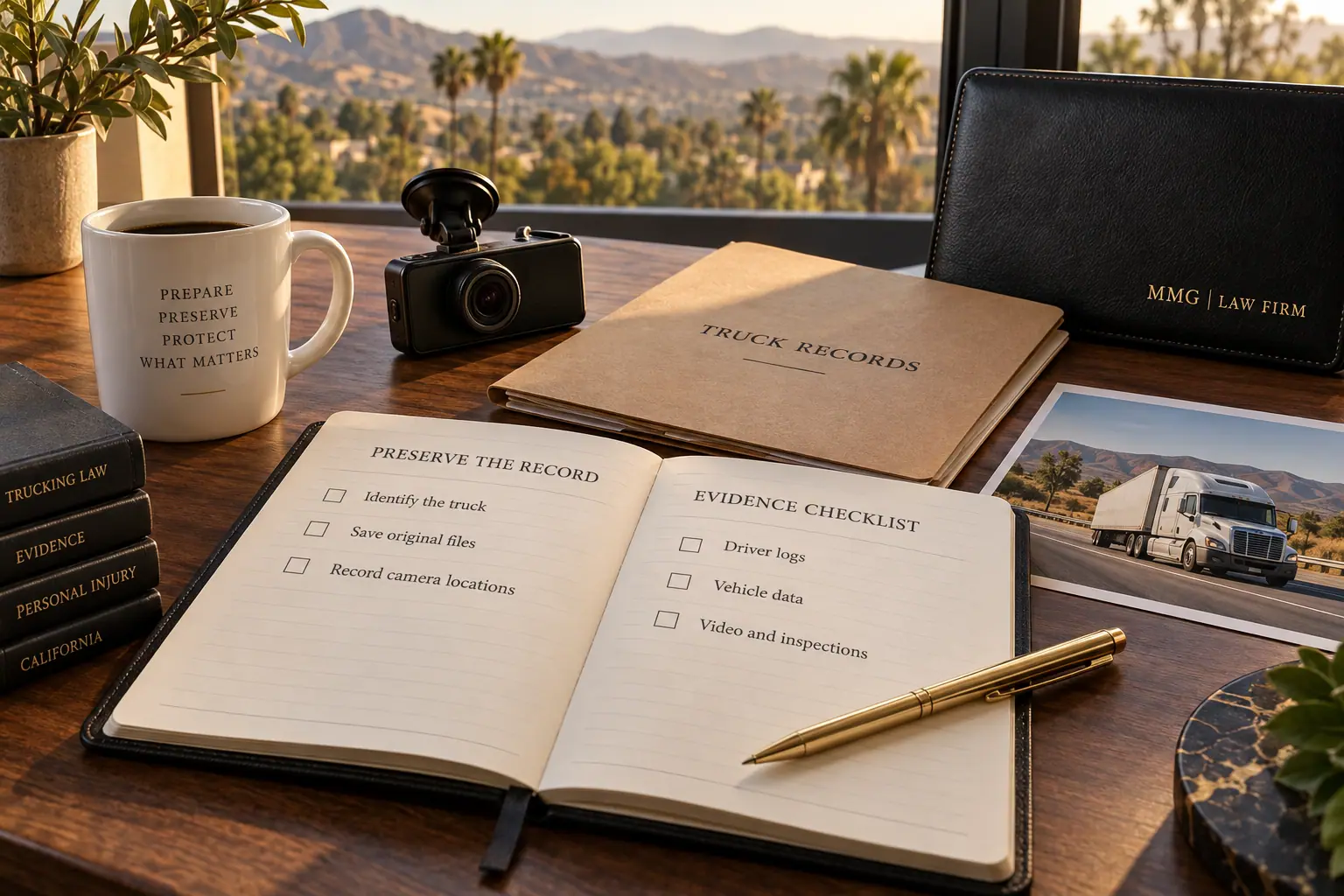
Protect the records that may explain the crash.
Driver logs, vehicle data, video, and inspection records.

01
Identify the records
Know what evidence exists and where it may be found.

02
Preserve original files
Take steps to keep the records in their original form.

03
Coordinate lawful access
Work with insurers, carriers, and others to obtain the records.
Different records. Different answers.
Specific records can help explain what happened.

Electronic logs
Duty status and driving time.

Vehicle data
System-dependent information about vehicle operation.


An ELD is not automatically a crash-data recorder.
Protect the records that may explain the crash
After a truck collision, important evidence may be held by the carrier, a vehicle owner, a repair facility, or a technology provider. Video may be overwritten, a truck may return to service, and damaged parts may be replaced. A prompt review can identify what may exist and who should be asked to preserve it.
MMG Law Firm can discuss the crash, potential evidence sources, and appropriate next steps. You do not need to know the trucking company’s data systems before calling.
Request a free case evaluation or call (818) 539-7969. No recovery, no attorney fees or case expenses owed to MMG. Medical bills and other third-party obligations are separate.
Start with the truck, the time, and the location
Safety and medical care come first. When you can safely gather information, keep the crash date, approximate time, location, police agency, and report number. Photographs of the carrier name, USDOT number, license plates, and tractor and trailer numbers can help identify the right vehicle and record holders. Do not approach a truck in active traffic to obtain them.
Save your own original photos, recordings, witness details, and insurer correspondence. Tell the reviewing attorney if a vehicle is scheduled for repair, sale, salvage, or disposal. An inspection may need coordination; do not attempt to remove equipment or download another person’s vehicle yourself. See what to do after a California accident.
 Keep the original filesDash camera footage, vehicle data, and other records can be critical.
 Understand the maintenance recordInspection reports can show past concerns and repairs.
Retention periods are not waiting periods.
Key records may be subject to specific time limits.

6 months
Covered duty-status records; from receipt.
3 months
Required driver inspection reports; from preparation.
14 months
Periodic inspection reports; from report date.

Other evidence
Video and vehicle data may follow different rules.
Selected federal rules. Coverage and exceptions apply. Preservation duties may require longer retention.
Different records answer different questions
Electronic logs: duty status and driving time
Electronic logging devices, or ELDs, support hours-of-service records. They may help show when a driver recorded driving, on-duty, off-duty, or sleeper-berth time. Relevant supporting records can help test the timeline and identify inconsistencies.
An ELD is not automatically a detailed crash recorder. FMCSA explains that ELDs are not required to collect speed, braking, steering, or other vehicle-performance parameters. Some fleet systems collect additional information, but that must be investigated separately. Read FMCSA’s ELD questions and answers.
Log compliance alone does not prove a driver was alert, and a log violation alone does not establish that it caused the crash. Logs must be compared with the other evidence.
Vehicle data: what the truck’s systems may retain
Engine-control modules, event recorders, braking systems, or telematics platforms may hold useful information, depending on the equipment. Available data may relate to speed, braking, engine activity, fault codes, or location. There is no universal truck “black box” that records every detail of every crash.
An appropriate specialist may need to identify the system, preserve available data, and document the collection method. Movement, repairs, module replacement, or later events may affect some records. The exact risks depend on the system; do not assume all data disappear in the same way or after the same interval.
Video: the truck, nearby vehicles, and surrounding properties
Dash cameras, inward-facing cameras, nearby businesses, and other vehicles may provide different views. Not every camera records continuously, and some systems store only selected events. Identify possible sources quickly, including the relevant time window before and after the collision.
A clip can omit what happened just outside its frame. Preserve the original file, available timing information, and surrounding footage where relevant. Camera clocks may need comparison with other records.
Inspection and maintenance records: reported problems and repairs
Driver vehicle inspection reports, periodic inspection reports, work orders, and repair histories may help identify reported brake, tire, lighting, or other equipment concerns. A recorded defect is not automatic proof of causation, and a clean inspection report does not establish the vehicle’s condition at the moment of impact.
Federal rules require covered carriers to systematically inspect, repair, and maintain equipment. 49 CFR 396.3 describes the maintenance and recordkeeping requirements.
Dispatch, cargo, and trip records
Relevant dispatch messages, delivery instructions, bills of lading, weight records, and loading or securement information may help explain the trip. Their importance depends on the issues: timing, route, cargo movement, or the roles of different businesses. A preservation request should identify relevant categories rather than assume every company holds every record.
How long must trucking records be kept?
There is no single retention period for all truck evidence. The following are selected federal requirements for records and operations covered by the cited rules, not a complete list:
- Duty-status records and supporting documents: Generally six months from receipt under 49 CFR 395.8(k). FMCSA also requires a separate-device backup of ELD records for six months; see its ELD retention guidance.
- Covered maintenance records: One year, and six months after the vehicle leaves the carrier’s control, under 49 CFR 396.3(c). The recordkeeping provision generally concerns vehicles controlled for 30 consecutive days, with stated exceptions.
- Required driver vehicle inspection reports and related certifications: Three months from preparation under 49 CFR 396.11(a)(4). Exceptions and report requirements matter; the rule does not require a report when no defect or deficiency is discovered or reported in the circumstances it describes.
- Periodic inspection reports: Fourteen months from the report date under 49 CFR 396.21.
These periods do not mean you should wait. They do not guarantee that a particular video, electronic event, or physical component will remain available. Separate litigation-preservation obligations may require relevant material to be kept longer than routine recordkeeping periods.
Federal and California requirements depend on the operation and applicable exceptions. CHP explains California’s requirements for intrastate electronic logging devices. A truck operating within California is not automatically exempt from electronic logging requirements.
What does a preservation request do?
A preservation request identifies a collision and asks a person or business to retain potentially relevant evidence. It can put the recipient on notice of a claim and identify records at risk of deletion, alteration, repair, or disposal.
Preservation is different from access. A letter is not a subpoena or court order. It does not automatically permit an inspection, require immediate production, or give you access to private accounts. Obtaining records may require agreement, formal discovery, a subpoena, or court action. California Courts explains discovery requests and third-party subpoenas.
A preservation duty can arise before a letter is sent, depending on the circumstances and applicable law. Conversely, sending a letter does not guarantee that material exists, will be preserved, or can be recovered if already lost.
What a focused request may address
- The crash date, location, involved driver, and identifying vehicle information.
- Relevant record categories and a justified time range.
- The tractor, trailer, involved components, and known electronic systems.
- Original files, available metadata, relevant edits, and audit history.
- Relevant copies held by employees, vendors, or service providers.
- Suspension of routine deletion for identified relevant material and coordination before changes that may affect an inspection.
The right recipients and scope depend on the facts. They may include the carrier, vehicle owner, repair or storage facility, and relevant technology or video providers. A request should not unnecessarily seek unrelated personal information or interfere with emergency safety measures.
Why original files and collection records matter
A screenshot or short exported clip may leave out information needed to understand the record. Where appropriate, preserve native files and keep track of when, how, and by whom copies were collected. Preserve originals without annotation and use separate working copies for notes.
Differences in time zones, clock settings, vehicle identifiers, or file versions can affect interpretation. A reliable timeline may require comparison among logs, video, vehicle data, dispatch records, and witness accounts. No single record necessarily resolves fault or injury causation.
What if evidence has already been deleted or changed?
Missing evidence does not automatically end a claim or prove misconduct. Copies may exist with another custodian, and other evidence may answer the same question. It can be important to establish what existed, when it changed, who controlled it, and whether a preservation duty applied.
Legal consequences for loss or destruction of evidence depend on the facts and governing rules; sanctions are not automatic. Tell counsel about known repairs, deletion notices, or disposal dates, and preserve those communications. Do not alter your own relevant records, including material that appears unfavorable.
No. Applicability and exemptions depend on the operation and equipment. Alternative duty-status or time records may still be relevant. The absence of an ELD does not by itself establish a violation.
No. It concerns specified log-related records. Video, vehicle data, and physical evidence present different preservation questions. Filing deadlines are also separate. Read California accident claim deadlines.
Do not assume so. A law-enforcement investigation may collect particular evidence for its purposes without preserving every carrier, vendor, or repair record relevant to a civil case.
Yes. Start with the location, date, police report number, photographs, and any vehicle information you have. Those details may help identify the appropriate parties. Read about California truck accident representation.
The case evaluation is free. MMG advances case expenses without upfront payment. Contingency percentages vary by case stage and are explained in the written agreement. If there is no recovery, no attorney fees or case expenses are owed to MMG. Medical bills and other third-party obligations are separate. See attorney fees and case costs.
A clear next step starts with a conversation.
EXPERIENCE. GUIDANCE. A STRONGER TOMORROW.
CALIFORNIA
PEOPLE
JUSTICE
A BRIGHTER TOMORROW
Start with what you have
Tell MMG what happened and whether you know of any upcoming repair, data deletion, or vehicle disposal. You do not need a complete evidence file to begin.
Request a free case evaluation or call (818) 539-7969. Phone and video consultations are available. Office visits at 100 W Broadway, Suite 540, Glendale, are by appointment.
For the broader process, see how an accident claim works. General information only; not advice about a particular case. Contacting MMG does not by itself establish an attorney-client relationship.
Electronic logs and vehicle data
Driver logs
May show duty status and driving time.
Vehicle systems
May hold additional operation or event data, depending on equipment.

Important distinction
ELDs are not required to record speed, braking, or steering.
A preservation request does not itself grant access.
Retention periods are not waiting periods.
6 months
Covered duty-status records, from receipt.
3 months
Required driver inspection reports, from preparation.
14 months
Periodic inspection reports, from report date.
Video and vehicle data
Availability varies by system and custodian.
Selected federal requirements. Coverage and exceptions apply. Preservation duties may require longer retention.
Your evidence preservation checklist
Keep originals unchanged. Do not access another person’s equipment.