
CALIFORNIA TRUCK ACCIDENT CLAIMS
California Truck Rollover Accident Lawyer
Understand the movement. Follow the evidence.
Speed, cargo, road conditions, and stability deserve careful review.
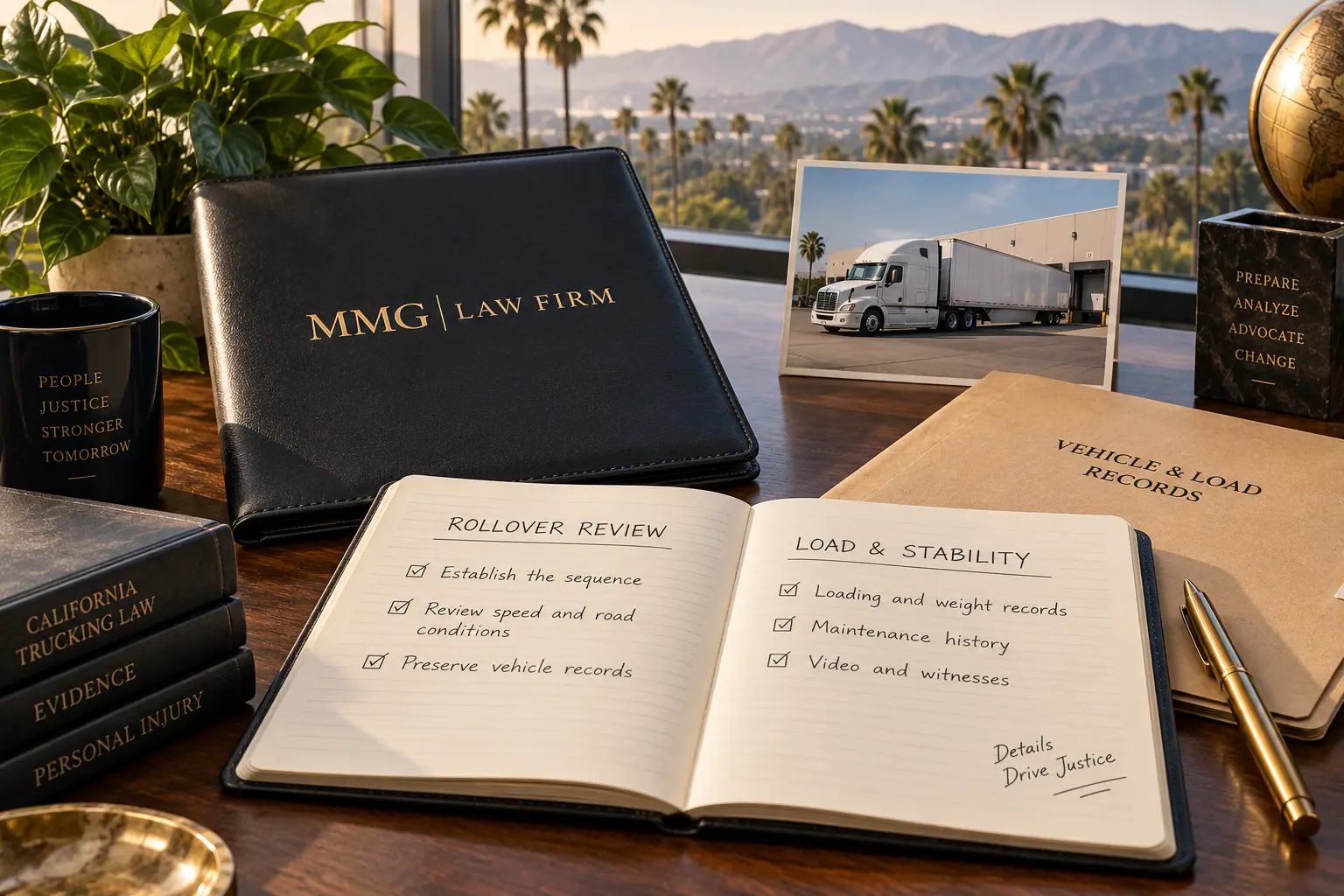
Establish the sequence
Reconstruct what happened before the truck tipped.
Preserve vehicle and load records
Secure driver, vehicle, and cargo data.
Document your losses
Track injuries, treatment, and long-term impact.
Four questions. A clearer picture.

Speed & maneuvering
What happened before the truck tipped?

Cargo & loading
How was the load arranged and secured?

Road & weather
What conditions did the driver encounter?

Vehicle stability
What equipment and records are available?

A rollover alone does not establish fault.
Understand why the truck overturned—and what comes next
A truck rollover can leave nearby drivers facing an overturned trailer, spilled cargo, or a sudden chain of collisions. For someone injured, the immediate concerns are medical care, disrupted work, and how to get reliable answers.
A rollover describes what happened to the truck. It does not, by itself, establish why it happened or who is responsible. An investigation should connect the truck’s movement to its speed, load, road conditions, equipment, and any other vehicles involved.
MMG Law Firm offers free case evaluations for California truck accident claims. Call (818) 539-7969 or request a consultation. You can call before every document is ready. A family member can make the initial inquiry if an injured person cannot.
Preserve evidence before it changes.
Video, loading records, and inspections can help establish the sequence.
Explore evidence preservationHow a rollover can develop
A truck rolls over when it tips onto its side or roof. Investigators may examine a turn or abrupt maneuver, a departure from the roadway, contact with a curb or uneven ground, or an impact with another vehicle. The order matters: a collision can precede the rollover, or the overturning truck can cause subsequent impacts.
A jackknife is a different movement, involving a tractor and trailer folding toward each other. A crash may involve both, but the terms should not replace a reconstruction of the sequence. See Jackknife Truck Accidents.
FMCSA’s cargo tank rollover prevention resource considers vehicle design, load effects, highway factors, and driver factors. Its training is specifically directed at cargo tank operations. It provides useful context, but findings about tank trucks should not be treated as proof about every tractor-trailer or individual crash.
Four questions that guide the investigation
Was speed appropriate for the situation?
An investigation should examine speed approaching a curve, ramp, lane change, or unexpected hazard—not simply the posted speed limit. Load characteristics, the roadway, and the maneuver may affect the analysis. Video, available electronic records, physical evidence, and qualified reconstruction may help assess speed and timing.
A photograph of the overturned truck cannot establish its earlier speed. Nor does a rollover automatically prove that the driver was speeding. Competing explanations should be tested against the evidence.
What was loaded, and how was it distributed?
The height and distribution of a load can affect stability. Relevant questions may include the type of cargo, loading arrangement, weight, securement, and whether material moved before or during the crash. Liquid cargo raises different questions from pallets, machinery, or loose materials.
For covered cargo, 49 CFR 393.100 addresses preventing cargo from escaping and preventing movement that adversely affects vehicle stability or maneuverability. Investigators should evaluate the actual loading system and applicable requirements.
Cargo scattered after a rollover does not alone establish that improper loading caused it. Loading documents, photographs taken before departure, and physical examination may help distinguish cause from consequence. Read Overloaded Trucks and Unsecured Cargo.
What role did the road and weather play?
Curve geometry, pavement condition, shoulder drop-offs, traction, visibility, and wind may warrant examination. Conditions at the precise location and time matter. A general weather report or photograph taken days later may not capture what the driver encountered.
For covered operations, 49 CFR 392.14 requires extreme caution when hazardous conditions affect traction or visibility, reduced speed, and discontinuing operation when conditions become sufficiently dangerous, subject to the rule’s limited exception. Weather is part of the investigation, not an automatic answer to responsibility.
If a roadway condition may be involved, identifying the responsible entity and reviewing any special claim requirements promptly can be important. See California Accident Claim Deadlines.
What do the vehicle and stability systems show?
Depending on the truck and circumstances, inspection may address tires, suspension, brakes, steering, coupling components, and electronic stability equipment. 49 CFR 396.3 addresses systematic inspection, repair, and maintenance for covered vehicles. An identified defect must still be connected to the crash or resulting harm.
Federal Motor Vehicle Safety Standard 136 addresses electronic stability control for covered heavy vehicles. Vehicle category, manufacturing date, and exceptions matter. The standard should not be described as requiring the same equipment on every commercial truck.
The presence of stability control does not mean that every rollover can be prevented. A rollover likewise does not establish that the system failed. Investigators may need to identify the installed equipment, available diagnostic or event records, warning history, and performance under the actual conditions. Related guidance: Truck Brake Failure and Poor Maintenance.
Evidence to preserve before it changes
- Truck, trailer, and relevant components: qualified inspections may help assess damage, condition, and the relationship between equipment and the crash.
- Original video and photographs: footage before the rollover can be especially useful. Preserve original files and identify nearby cameras promptly.
- Scene evidence: road measurements, tire marks, debris, shoulder conditions, and vehicle resting positions may help establish movement and timing.
- Loading and weight records: shipping documents, loading photographs, weight tickets, and available instructions may clarify the load before the event.
- Vehicle and trip data: available telematics, event records, dispatch messages, and duty-status logs may help answer different questions. Not every system records the same information.
- Inspection and maintenance history: records may reveal earlier concerns, repairs, component changes, or diagnostic warnings.
- Witness information: record where each witness was located and what they observed before, during, and after the rollover.
Repairs, salvage, cleanup, and routine overwriting may change or remove evidence. Tell the attorney where the vehicles are stored and whether disposal is planned, if you know. A preservation request identifies material to retain; it does not itself compel disclosure or authorize entry onto private property.
Do not inspect unstable vehicles, enter traffic, handle spilled cargo, or arrange testing yourself. Evidence collection should be coordinated safely and appropriately. Read Truck Accident Evidence Preservation.
Who may need to be investigated?
Potentially relevant parties may include the driver, motor carrier, equipment owner, loading business, maintenance provider, manufacturer, or another motorist. Roadway-related claims may raise additional requirements. The facts and applicable law determine which parties, if any, are responsible.
Company records can help identify who controlled the trip, supplied the equipment, performed repairs, or loaded the trailer. A company’s name on the truck does not resolve all business relationships or insurance questions. See Trucking Company Liability.
If several vehicles were involved, the investigation should distinguish the initial event from later impacts. Different insurers may advance conflicting explanations. Preserve correspondence and the information supporting each account. Read Multi-Vehicle Accident Lawyer.
Document injuries and long-term needs
Seek appropriate medical care and follow your clinicians’ instructions. Save treatment records, receipts, missed-work information, and records of assistance needed at home. Serious injuries may require documentation of rehabilitation, reduced earning capacity, and medically supported future care.
A claim should reflect the person’s actual losses and prognosis. The collision type alone cannot establish a case value. Related MMG guides explain Catastrophic Injuries, Spinal Cord Injury and Paralysis, and Compensation Available After an Accident.
What you can do now
Prioritize safety and medical needs. Save the crash report number, original photos and videos, witness details, and insurer communications. Make a short timeline while events are fresh, distinguishing what you saw from information received later.
Have deadlines reviewed promptly. The California Courts’ filing-deadline guidance explains that time limits depend on the claim and circumstances. Insurance discussions and evidence-preservation efforts do not automatically extend the time to file.
No. The investigation should address the driver’s conduct, equipment, load, roadway, other vehicles, and causation. The truck’s final position alone does not decide responsibility.
Yes. The arrangement and movement of cargo may raise stability questions independently of total weight. Investigators need evidence of the actual load rather than assumptions based on the wreckage.
Identify the system and preserve available records. Its presence does not guarantee prevention of a particular crash, and the occurrence of a rollover does not establish a malfunction.
A claim may still require review if the rollover, spilled cargo, or evasive action led to your injury. Proving the sequence and evaluating coverage may be especially important. Save witnesses and original video where available.
The case evaluation is free. MMG advances case expenses. Contingency rates vary by case stage and are explained in the written agreement. No recovery means no attorney fees or case expenses owed to MMG. Medical bills, liens, and other third-party obligations are separate. Read Attorney Fees and Case Costs.
Talk with MMG about your next step
Tell the firm where the crash happened, what you know about the vehicles, and your immediate concerns.
PREPARE.
ANALYZE.
ADVOCATE.
Call (818) 539-7969 or request a free case evaluation. Tell the firm where the crash happened, what you know about the vehicles, and your immediate concerns. Phone and video consultations are available. Visits to 100 W Broadway, Suite 540, Glendale, are by appointment.
Explore Truck Accident Lawyer for broader claim guidance. This page provides general information. Contacting MMG does not by itself establish an attorney-client relationship.
Preserve the evidence
Start with what you already have.

Coordinate inspections before repairs or disposal.
Speed & maneuvering
What was the approach?
Speed approaching a curve, ramp, lane change, or hazard.
What maneuver occurred?
A turn, abrupt steering, or departure from the roadway.
What can the evidence establish?
Video, electronic records, and reconstruction may help assess timing.
A photograph of the overturned truck cannot establish its earlier speed.
Cargo & loading
What was on the truck?
Identify cargo type and weight records.
How was it arranged?
Review loading photos and securement records.
When did it move?
Distinguish movement before impact from crash damage.
Scattered cargo alone does not establish improper loading.
Road & weather
What was the roadway?
Curve geometry, pavement, and shoulder drop-offs.
What were the conditions?
Traction, visibility, and wind at that time and place.
How did the driver respond?
Caution, reduced speed, or discontinuing operation.
Weather is part of the investigation, not an automatic answer to responsibility.
What can stability records show?
Identify the equipment
Vehicle type, manufacturing date, and installed systems matter.

Review available records
Look for warnings, repairs, and event data.
Examine the crash conditions
Connect equipment evidence to the actual sequence.
Stability control does not guarantee rollover prevention.
A rollover alone does not prove a system failure.