
CALIFORNIA
Uninsured and Underinsured Motorist Claims
When the other driver has too little insurance, understand your options.
CLEAR GUIDANCE.REAL ANSWERS.CALIFORNIA FOCUSED.
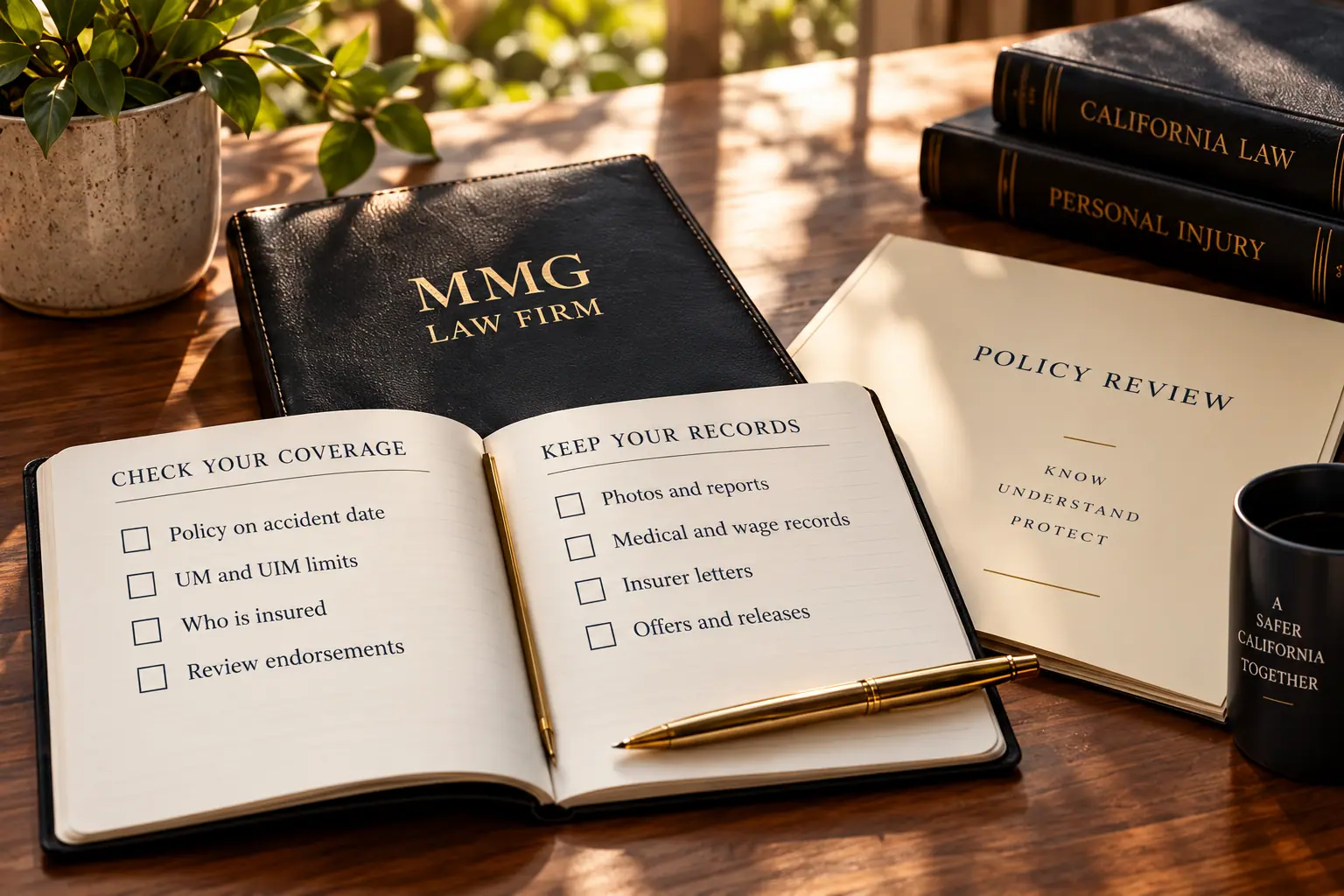
Start with the coverage you actually have.
Your policy, the accident facts, and applicable requirements determine what may be available.
 Uninsured motoristNo applicable liability coverage.Underinsured motoristApplicable liability limits below your UIM limits.
Coverage is not automatic.
When the other driver's insurance is not enough
An accident can leave you facing treatment, missed work, and unanswered questions about payment. If the responsible driver has no applicable insurance—or insufficient coverage—your own uninsured or underinsured motorist coverage may provide another route to recovery. Coverage is not automatic: the policy, the people insured, the accident facts, and applicable requirements all matter.
MMG Law Firm can review your circumstances, available insurance documents, and potential representation after a California car, truck, or motorcycle crash. You do not need to know the correct insurance term before calling.
Request a free case evaluation or call (818) 539-7969. Bring what you have; missing information can be discussed during the consultation.
UM and UIM: two different coverage questions
Uninsured motorist bodily injury coverage (UM) may respond when a legally responsible driver has no applicable liability insurance, subject to coverage requirements. Certain unidentified-driver situations can also involve UM, but additional conditions matter.
Underinsured motorist bodily injury coverage (UIM) may respond when applicable liability limits are lower than your UIM limits. Having losses greater than the other driver's insurance does not, by itself, establish UIM eligibility.
Vehicle damage is a separate issue. Bodily injury coverage should not be confused with collision coverage, uninsured motorist property damage, or a collision deductible waiver. Ask which coverage addresses each loss.
The California Department of Insurance explains that insurers must offer UM/UIM and that declining it involves a waiver. Check the actual policy rather than assuming coverage exists because you bought auto insurance. Read the Department's automobile insurance guide.
Start with the policy in effect on the accident date
An insurance card usually does not show everything needed to evaluate a claim. Collect the declarations page, full policy, endorsements, and any coverage-selection or rejection documents. Save the versions covering the accident date, not just a later renewal.
Questions to review include:
- Who qualifies as an insured under this policy?
- What are the bodily injury limits per person and per accident?
- Does the policy include UM/UIM, and were limits reduced or coverage rejected?
- What notice, cooperation, and dispute-resolution provisions apply?
- Are there exclusions relevant to the vehicle, driver, household, or vehicle use?
- Could another potentially applicable policy require review?
Do not assume that multiple vehicles or policies allow limits to be added together. Coverage coordination and anti-stacking rules require individual analysis. Passengers, household members, pedestrians, cyclists, and motorcycle riders should have their circumstances reviewed rather than relying on a general rule about who is covered.
Understand UIM limits before counting on a payment
California UIM generally operates with a credit for payments from the responsible driver or that driver's insurer. It is not ordinarily the driver's payment plus your full UIM limit. Relevant liability limits must be exhausted through payment of settlements or judgments, with proof supplied to the UIM insurer before that coverage applies.
Illustration only—not an MMG case result: Assume one injured person has $100,000 in applicable UIM coverage and receives $30,000 from the responsible driver's liability insurer. The simplified remaining UIM ceiling is $70,000, subject to covered damages, all applicable requirements, and other relevant credits. A ceiling is not a promised payment.
If applicable liability limits equal or exceed your UIM limits, UIM may not be triggered even when your losses are larger. Multiple injured people, multiple responsible vehicles, and other payments can make the analysis more complex.
The California Supreme Court discusses exhaustion and credits in Quintano v. Mercury Casualty Co., available through Stanford Law's court-opinion collection. The opinion is legal background, not a substitute for current policy and statutory review.

Review before signing a release.
Check coverage, payments, deadlines, and the rights being released.
 A claim number does not protect every deadline.UM and UIM timing require separate review. Different notice and filing requirements may apply.
Before you sign a release or accept a settlement
Ask how the proposed settlement affects every potential claim. Review what rights the release gives up, which policies have been identified, whether required liability limits have been paid, and what documentation your insurer needs.
UM and UIM have different settlement rules. A consent-to-settle provision affecting UM should not automatically be applied to UIM. In Quintano, the Court explains the distinction and prior authority addressing it. Obtain advice about the specific claim before signing; a general statement that insurer consent is always required for both coverages would be misleading.
Keep written offers, releases, payment records, and insurer correspondence. Ask for an explanation of deductions and estimated net proceeds before deciding. Attorney fees, case expenses, medical reimbursement obligations, and liens can affect what you receive.
Hit-and-run claims require urgent review
If a driver leaves the scene, prioritize safety and medical care. Report the incident promptly to law enforcement and your insurer, preserve evidence when safe, and save witness contact information, photographs, video, and the report number.
Unknown-driver UM claims can involve physical-contact, reporting, and sworn-statement requirements. Section 11580.2(b) specifies a police report within 24 hours and a sworn statement to the insurer within 30 days thereafter for the unknown-driver situation it describes. Obtain immediate advice about compliance and any applicable exception. A vehicle swerving without contact raises different issues from a documented collision. Do not assume every hit-and-run is covered, or that an ordinary claim notification satisfies every required step.
Ask for immediate review of California Insurance Code section 11580.2 and the policy. If time has already passed, seek advice about the actual facts and any applicable exception rather than concluding the claim is lost.
Reporting a claim does not settle every deadline
Notify your insurer promptly and preserve proof of what you sent and when. A phone call or claim number does not necessarily protect every legal deadline.
California UM claims have statutory steps for preserving rights, including a two-year requirement under section 11580.2(i), subject to applicable rules and exceptions. Formal arbitration initiation has specific requirements; an informal request to discuss payment is not necessarily sufficient. UIM timing requires separate analysis and should not be treated as identical to UM timing.
Claims against the responsible driver and claims involving government entities can have separate deadlines. Do not wait for insurance negotiations to finish before asking what must be done. See California Courts' personal injury guidance and government-claim guidance.
Build a record of fault, injuries, and losses
A claim with your own insurer still requires support. Organize evidence about how the collision happened, why another driver was responsible, and how the injuries affected you.
- Accident report information, photographs, video, witness details, and repair records.
- Available information about the other driver's coverage, coverage denials, and policy-limit communications.
- Medical records and bills, treatment recommendations, and relevant prior history.
- Wage records, time missed from work, and supported changes in earning ability.
- A dated record of practical limitations and help needed at home.
- Insurer letters, claim numbers, settlement documents, and proof of payments.
Keep originals and copies. Do not alter records, guess about missing facts, or access someone else's private information without permission. Treatment decisions belong with healthcare professionals. The Department of Insurance's after-an-accident guide describes loss documentation for medical-payment and uninsured motorist claims.
What if your insurer disputes the claim?
Ask whether the dispute concerns coverage, responsibility, the connection between the crash and injury, or the amount of damages. Request the insurer's position and supporting policy provisions in writing.
Disagreements about fault and damages may go through arbitration under the policy and statute; coverage disputes can require a different process. A denial or low offer does not alone establish insurer bad faith. Review the reasons, supporting evidence, available response options, and deadlines.
For consumer assistance, use the California Department of Insurance's complaint resources. A complaint is not a substitute for filing suit, initiating arbitration, or satisfying claim-preservation requirements.
How MMG can help you evaluate next steps
A consultation can focus on identifying potentially applicable policies, separating UM from UIM issues, reviewing deadlines and settlement documents, and organizing evidence of losses. If MMG accepts representation, the written agreement defines the scope and fee terms. No recovery or particular payment is guaranteed.
MMG's contingency rates vary by case stage. MMG advances case expenses without an upfront payment. If there is no recovery, no attorney fees or case expenses are owed to MMG. Medical bills, liens, reimbursement claims, and other third-party obligations are separate. Ask how fees and expenses are calculated and deducted if recovery occurs.
Frequently asked questions
Potentially, if an applicable policy provides coverage for you and the accident. Your insurer still evaluates coverage and evidence. Having paid premiums does not guarantee a particular claim payment.
Other potentially responsible people or applicable policies may warrant investigation. Medical payments, health insurance, and vehicle-damage coverage address different needs. There may be no collectible recovery source; review the facts before assuming either that payment is available or that no options exist.
No. Coverage, evidence, and deadlines can be discussed while treatment continues. Future care and the consequences of signing a final release need individual evaluation.
No. Eligibility, covered damages, your limits, liability payments, and relevant credits restrict what may be available. The example above illustrates a simplified ceiling, not the value of your claim.
Bring policy documents, claim letters, the accident date and report information, any settlement offer, and available medical or wage records. Missing documents should not keep you from asking about urgent deadlines.
Discuss your uninsured or underinsured motorist claim.
Get clear answers about your options.
Talk with MMG about your coverage questions
Request a free case evaluation or call (818) 539-7969. Tell us the accident date, general circumstances, and whether any offer, denial, or release is pending. Avoid including sensitive medical details in a general website form.
MMG's Glendale office is at 100 W Broadway, Suite 540. Visits are by appointment; phone and video consultations are available. Learn about Mihran M. Ghazaryan, or explore MMG's car, truck, and motorcycle accident pages.
This page provides general California information, not advice for a particular claim. An inquiry alone does not create an attorney-client relationship. See MMG's legal disclosures and privacy policy.
Review before signing a release
Check the policies
Identify potentially applicable coverage.
Review payments
Keep proof of liability payments.
Understand the release
Discuss the rights being given up.
UM and UIM have different settlement requirements.Prepare for a coverage review
Policy documents
Claim records
Before settling
This checklist does not determine coverage or preserve deadlines.