
Rideshare Accidents · Uber Accident
Uber & Lyft Accident Lawyer California: Who Pays?
The driver's app status at the moment of impact decides whether a $1 million policy or a bare-minimum personal auto policy covers your injuries.
Mihran M. Ghazaryan··6 min read
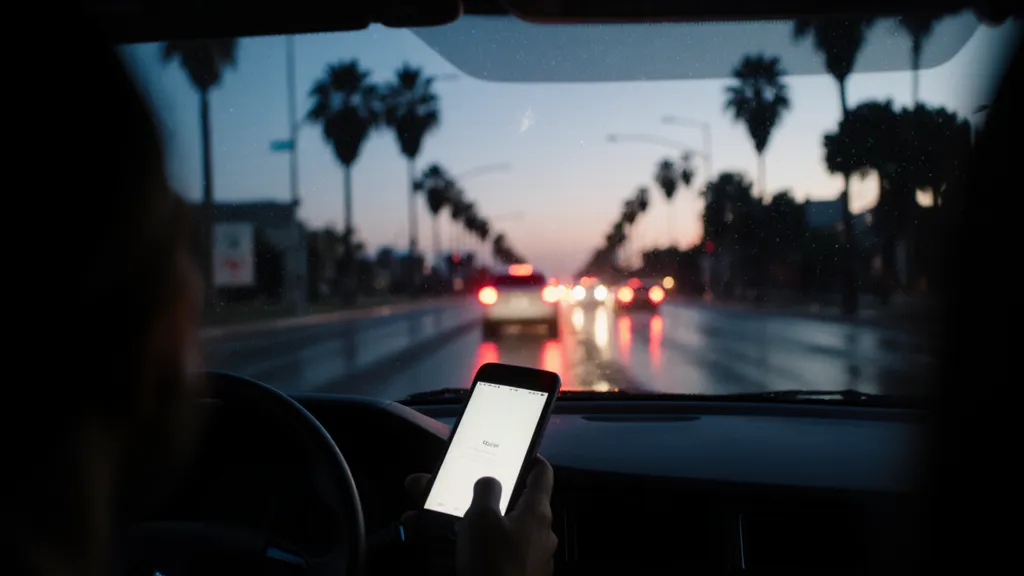
The insurance question that decides your Uber or Lyft case has almost nothing to do with how badly you were hurt. It depends on what the driver's app was doing at the moment of impact — off, on and waiting, or mid-trip with a passenger in the back seat.
That single detail can move the available coverage from a $15,000 personal auto minimum to a $1 million commercial policy. Here is how California rideshare accident claims actually work, and what an experienced rideshare accident lawyer looks at first.
Why Uber and Lyft Crashes Are Not Ordinary Car Accident Claims
In California, Uber and Lyft are regulated as Transportation Network Companies (TNCs) by the California Public Utilities Commission. Because of that status, they must carry layered commercial insurance that ordinary drivers never have — but they only have to provide it during specific windows of app activity.
Add to that a second wrinkle: rideshare drivers are classified as independent contractors under Proposition 22, which makes it difficult to hold Uber or Lyft directly liable for a driver's negligence the way you could sue a trucking company for its employee. The practical result is that most claims are paid through the TNC's insurance policy rather than through a lawsuit against the corporation itself.
The Three Insurance Periods That Control Your Claim
California Public Utilities Code section 5433 sets the minimum coverage a TNC must maintain at each stage. Understanding which period applies is the first thing an Uber accident lawyer establishes.
- Period 0 — App off. The driver is off duty and driving personally. Only the driver's own personal auto policy applies. California's minimum liability limits are low, so uninsured/underinsured motorist coverage on your own policy often matters here.
- Period 1 — App on, waiting for a request. The TNC must provide contingent liability coverage of at least $50,000 per person / $100,000 per accident for injuries and $30,000 for property damage. This layer typically sits behind the driver's personal insurance.
- Periods 2 and 3 — Ride accepted, and passenger on board. From the moment the driver accepts the request until the passenger is dropped off, a $1 million commercial liability policy applies, along with $1 million in uninsured/underinsured motorist coverage.
Why Period 1 Cases Get Denied So Often
Personal auto policies frequently contain a livery exclusion — language that voids coverage while the vehicle is being used for commercial ride-hailing. When a driver was logged in and waiting, the personal insurer may deny, and the TNC's contingent policy may argue it was never triggered. That gap is where claims stall, and where preserving the driver's trip log early becomes essential.
Who Can Recover After a Rideshare Crash
You do not have to be the passenger to have a claim. People who commonly recover include:
- Rideshare passengers, who are almost never at fault and are usually covered by the $1 million policy
- Occupants of the other vehicle struck by a rideshare driver
- Pedestrians and cyclists hit during an active trip
- The rideshare driver, who may have a claim against the at-fault third party and, in periods 2–3, access to UM/UIM coverage
- Family members pursuing a wrongful death claim
California follows pure comparative negligence, so even a partially at-fault claimant can recover — the award is simply reduced by their percentage of fault. We break that down further in our guide to comparative negligence in California.
What to Do in the First 48 Hours
Rideshare evidence is digital, and it disappears or becomes harder to obtain over time.
- Screenshot the trip in your app — driver name, vehicle, trip ID, timestamps, and route. This is the single most valuable piece of evidence you can gather.
- Report the crash through the app, which creates a record that the trip was active.
- Call police and get a report number. Photograph vehicles, positions, and the scene.
- Get medical attention the same day. Gaps in treatment are the most common argument adjusters use to discount injuries.
- Do not give a recorded statement to any insurer before you understand which policy applies.
- Keep every bill and out-of-pocket receipt, including missed work.
If you are unsure how treatment gets paid while the claim is pending, see who pays medical bills after a California car accident.
Deadlines You Cannot Miss
In California, the general deadline to file a personal injury lawsuit is two years from the date of the injury (Code of Civil Procedure § 335.1). Property damage claims generally carry a three-year deadline.
There is a critical exception: if a government entity is involved — a city bus, a public agency vehicle, or a dangerous roadway condition — you generally must file an administrative claim with that entity within six months before you can sue. Deadlines can shift based on the injured person's age, discovery of the injury, and other facts, so confirm your specific dates with an attorney rather than assuming. General information on court procedures is available through California Courts Self-Help.
What These Claims Are Actually Worth
Be skeptical of any firm that quotes a number before reviewing records. Value in a rideshare case is built from economic damages (medical treatment past and future, lost earnings, reduced earning capacity, property damage) and non-economic damages (pain, suffering, loss of enjoyment of life). A soft-tissue injury that resolves in eight weeks and a spinal surgery are not remotely comparable claims, and the presence of a $1 million policy is a ceiling on available coverage — not a promise of payment.
The factors that genuinely move value are the severity and permanence of the injury, the consistency and documentation of treatment, clear liability, and the applicable policy limits.
Frequently Asked Questions
Can you sue Uber or Lyft directly after an accident?
Sometimes, but it is difficult. Because drivers are treated as independent contractors, claims are usually made against the TNC's insurance policy rather than the company itself. Direct claims against Uber or Lyft are more viable in cases involving negligent hiring, retention, or a company-specific failure.
Who is liable in an Uber accident in California?
Whoever caused the crash. That may be the rideshare driver, another motorist, or both. The liable party's conduct determines fault; the driver's app status determines which insurance policy pays.
Does the $1 million policy always apply?
No. It applies only from the moment the driver accepts a ride request through drop-off. If the app was off or the driver was merely waiting for a request, lower limits or the driver's personal policy apply instead.
What if the at-fault driver had no insurance?
During an active trip, Uber and Lyft carry $1 million in uninsured/underinsured motorist coverage, which can apply when the at-fault driver has no or insufficient coverage. Your own UM/UIM coverage may also stack into the picture.
How much does a rideshare accident lawyer cost?
Injury cases are handled on contingency — no upfront fee, and no attorney's fee unless there is a recovery.
Talk to a California Rideshare Accident Lawyer
If you were injured as a passenger, a driver, or someone struck by an Uber or Lyft, the app data that determines your coverage is being logged right now — and insurers know how to use it. MMG Law Firm offers a free, no-obligation consultation, works on a contingency fee for injury cases (no fee unless we win), and serves clients across California. Learn more about our rideshare accident practice or contact us to have your case reviewed.