
CALIFORNIA PERSONAL INJURY LAW
Partial Fault in a California Accident
Shared responsibility. Understand your options.
CLEAR ANSWERS. STRONGER TOMORROWS.
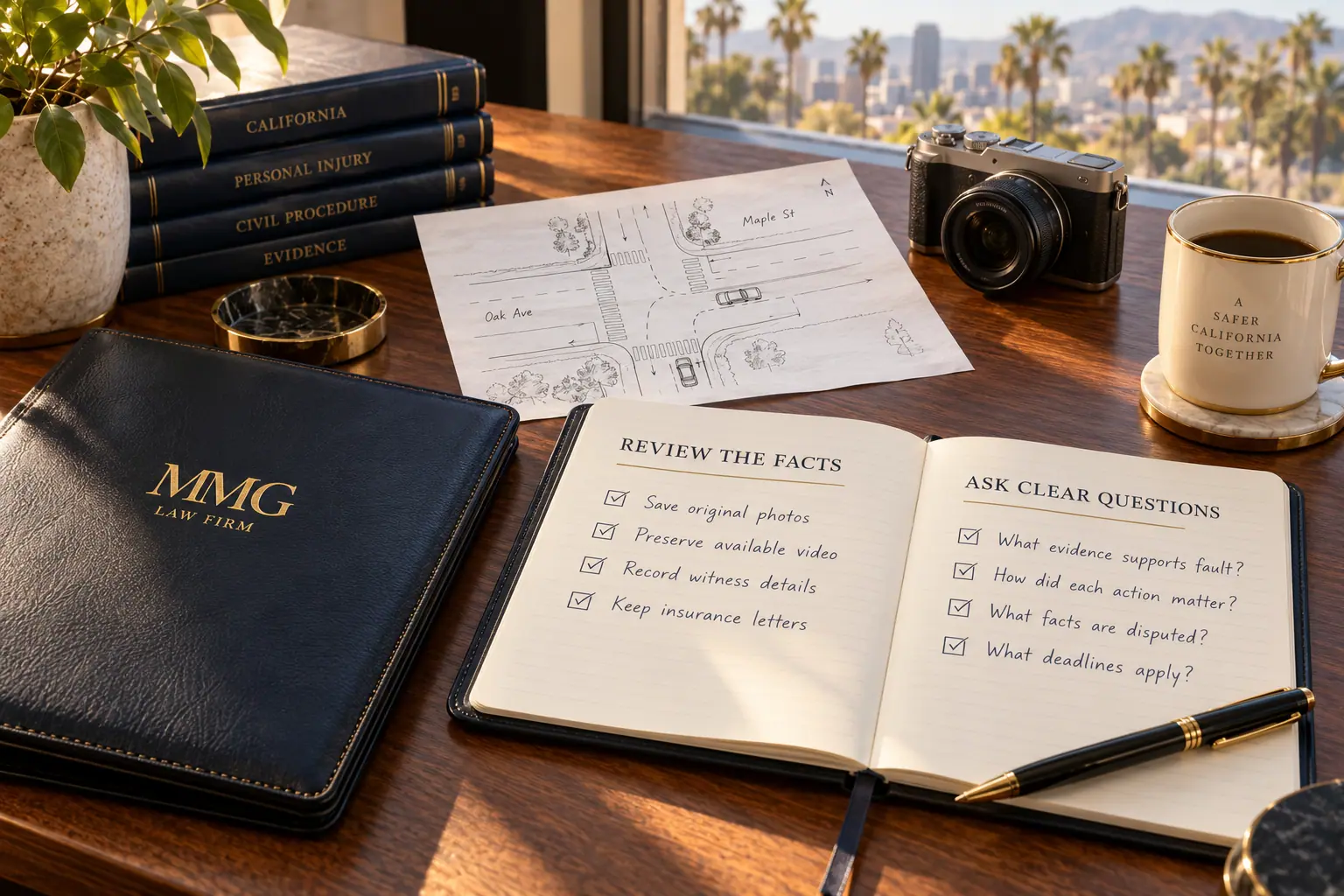
Partly at fault? You may still have a claim.
California generally reduces damages by your share of responsibility.
An accusation is not the whole story.
Review what happened, what the evidence shows, and how each action contributed.

Can you recover compensation if you were partly responsible?
Yes, potentially. California generally uses pure comparative negligence in accident injury cases. Sharing responsibility does not automatically prevent recovery, even if your share exceeds 50%. Your damages can be reduced to reflect your own responsibility. You still need a valid claim against another responsible party.
The California Supreme Court adopted this approach in Li v. Yellow Cab Co.. The rule is a starting point—not a guarantee of payment or a substitute for reviewing the evidence, applicable law, and insurance.
MMG Law Firm offers free case evaluations for California accident claims. Call (818) 539-7969 or request a free case evaluation. You do not need to know your percentage of fault before contacting the firm.
How a fault reduction works
HYPOTHETICAL EXAMPLE
$100,000
Established damages
$20,000
20% share of fault
$80,000
Before other limits and deductions
Illustration only—not an MMG result or settlement estimate. Fees, costs, liens, coverage, and other rules may affect payment.
How a fault reduction works
For a simplified illustration, assume legally established damages of $100,000 and an injured person's share of responsibility of 20%. The comparative-fault reduction would be $20,000, leaving $80,000 before other limits and deductions.
$100,000 × (1 − 20%) = $80,000
These are invented figures to explain the arithmetic, not an MMG case result or an estimate of your case. Insurance limits, collectability, other legal rules, attorney fees, case expenses, and medical repayment obligations can affect what is actually received. Read more about medical bills and liens.
Your fault percentage and the value of your losses are separate questions. A percentage cannot tell you what your claim is worth without evidence of the damages and who is legally responsible for them.
What must support a claim that you share fault?
California's CACI 405 jury instruction explains that a defendant asserting the injured person's comparative negligence must establish negligent conduct and that the conduct was a substantial factor in causing the harm. An accusation alone is not proof.
Relevant questions include what each person did, what reasonable care required under the circumstances, and how the conduct contributed to the injury. The Judicial Council's official civil jury instruction collection includes CACI 405 and the related apportionment instruction, CACI 406. A readable reproduction of CACI 405 is also available.
Who decides the percentage?
During a claim, insurers and the people involved may disagree about responsibility. An adjuster's proposed allocation is a position to examine, not automatically a binding court decision. Settlement negotiations may resolve the dispute; if the case goes to trial, the factfinder evaluates the evidence under the applicable instructions.
Ask for the factual basis of a proposed reduction. Which actions are being alleged? What photos, witness statements, recordings, or other records support them? What contrary evidence was considered? Keep the explanation and related correspondence.
A police report can help an investigation, but it is not itself a civil judgment allocating damages. The absence of a citation also does not establish that someone was free from negligence. Tell counsel about any citation, hearing, admission, or prior decision so its particular significance can be assessed.
Examples of disputes that need closer review
One driver turned while another may have been speeding
An investigation may need to examine timing, visibility, signals, speed, and the opportunity to avoid impact. Neither the direction of travel nor one person's description determines the entire allocation. Video, vehicle positions, and witness observations may clarify the sequence.
Two vehicles changed position before a collision
Lane changes, merging, braking, or following distance may be disputed. Preserve the full recording rather than a selected clip; what happened before impact may matter. Avoid guessing at another vehicle's speed or distance when you did not observe it reliably.
A passenger is worried about the driver's mistake
Being a passenger in a vehicle whose driver may be responsible does not by itself establish that the passenger was negligent. Passenger claims need their own analysis, including potential claims against more than one driver and available insurance.
These are investigation examples, not predetermined fault percentages. Relevant questions can arise in car, truck, and motorcycle cases.
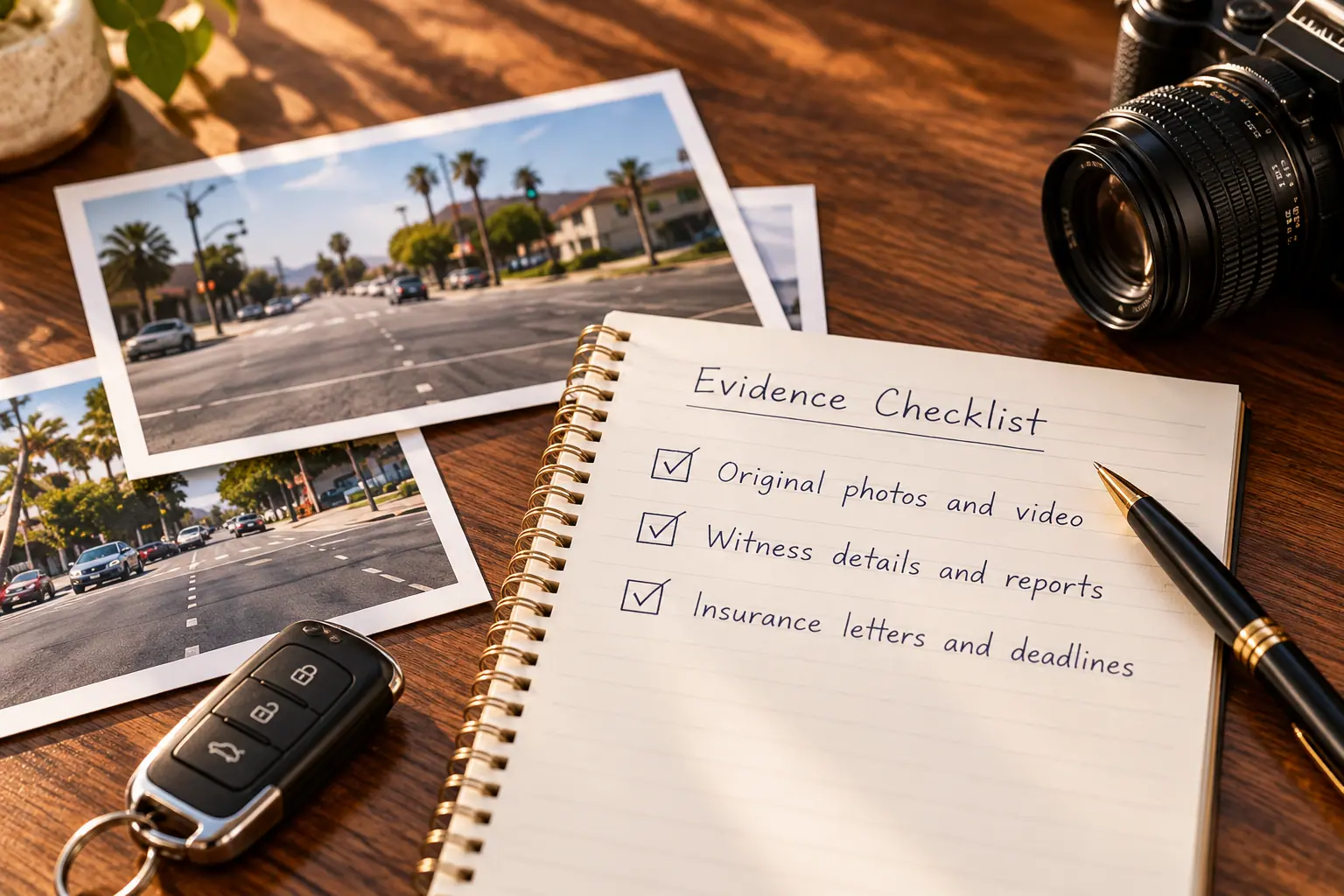
Preserve the facts that matter.
Contemporaneous evidence can make a real difference. Start by collecting and saving:
- Original photos and video
- Witness details and reports
- Insurance letters and deadlines
Evidence that can help resolve a fault dispute
Preserve what is available without risking your safety or interfering with emergency responders:
- Original photographs: vehicle positions, damage, road layout, signs, signals, visibility, and relevant road conditions.
- Video sources: dashcams and nearby cameras; note the location and approximate time promptly because recordings may be overwritten.
- Witness information: names, contact details, and what each witness actually observed.
- Reports and correspondence: report numbers, diagrams, citations, insurer letters, and written explanations of fault decisions.
- Injury and loss records: treatment records, work restrictions, receipts, and other documents supporting the claimed harm.
Keep original files and any available timestamps. Do not delete, edit, or selectively alter unfavorable material. If a vehicle may contain relevant electronic data, discuss preservation before repairs or disposal when feasible. The need for specialized analysis depends on the case.
What to do if an insurer says you caused the accident
Stay factual. Describe what you personally observed and say when you do not know. Do not guess at a legal percentage or change your account to fit what you think an adjuster wants to hear.
Ask for the decision and supporting reasons in writing. Keep a list of disputed points and documents that may clarify them. Before agreeing to a release or giving a detailed recorded statement to another party's insurer, consider discussing the request with counsel. Your own policy may require timely notice and cooperation, so do not simply ignore requests from your insurer.
Continue appropriate medical follow-up. Do not delay treatment to resolve a blame dispute. Keep any claim deadlines in view while discussions continue.
Partial fault is only one part of the legal analysis
More than one responsible party
Several people or businesses may have contributed to the harm. California distinguishes between categories of damages when allocating responsibility among defendants. For example, Civil Code section 1431.2 addresses several liability for noneconomic damages. A simple two-person percentage illustration does not resolve every multi-party case.
Insurance and other legal limits
A finding of fault does not establish how much insurance is available or whether a judgment can be collected. Separate rules may also restrict certain damages. For example, Civil Code section 3333.4 can limit noneconomic recovery for certain uninsured owners or drivers and certain drivers convicted of driving under the influence. Exceptions and the person's circumstances require review; lack of insurance is not itself a finding that the person caused the crash.
For an example of why the claim type matters, the California Supreme Court addressed a product-defect exception in Hodges v. Superior Court, available through Stanford's California Supreme Court Resources. That decision does not create a blanket exception for every uninsured claimant.
Filing deadlines still apply
California personal injury lawsuits generally have a two-year deadline. Public-entity claims can require an earlier administrative claim, commonly within six months. Exceptions and additional deadlines may apply. Ongoing negotiations or an unresolved fault dispute do not automatically extend the time to act. See the California Courts guides to personal injury cases and deadlines to sue.

An insurer’s percentage is a position to review.
Ask what evidence supports it. A proposed allocation is not automatically a court finding.
Do not assume you are disqualified because you may bear most of the responsibility. California's general pure comparative-negligence rule does not use a 50% or 51% cutoff. Whether another party bears legally actionable responsibility still needs investigation.
Not necessarily. Ask what supports the allocation and whether important evidence is missing. The effect of a decision can change if you have signed a settlement, completed an arbitration, or received a judgment, so share those documents promptly.
Tell your lawyer exactly what you said and in what circumstances. A statement may become part of the evidence, but its significance requires context. Do not assume it settles every legal issue, and do not try to conceal it.
Comparative negligence does not create a claim against a person who bears no legal responsibility for your harm. Benefits under your own insurance may involve different coverage rules. Have the evidence and policy reviewed rather than assigning yourself a final percentage.
MMG advances case expenses without an upfront payment. If there is no recovery, no attorney fees or case expenses are owed to MMG. Medical bills, liens, and other third-party obligations remain separate. Contingency rates vary by case stage and are explained in the written agreement.
Start with the facts you have.
A consultation can cover the accident, why fault is disputed, available records, insurance, and deadlines. Bring photographs, claim letters, report information, and your questions.
PEOPLE.
PERSPECTIVE.
A SAFER CALIFORNIA.
You can also read how an accident claim works and compensation available after an accident.
Request a free case evaluation · Call (818) 539-7969
MMG Law Firm · 100 W Broadway, Suite 540, Glendale, California. Visits by appointment; phone and video consultations available. Please do not include sensitive records in an initial website message. Contacting the firm does not create an attorney-client relationship. This page provides general information; individual facts and applicable law determine the available options.
How a fault reduction works
HYPOTHETICAL EXAMPLE
$100,000
Established damages
$20,000
20% share of fault
$80,000
Before other limits and deductions
This is not a case result, settlement estimate, or take-home amount.
Fees, costs, liens, coverage, and other rules may affect payment.
Your evidence checklist
Collect and preserve the information that can help support your claim.

Scene and vehicles

Video and witnesses
Reports and insurance

Injuries and losses
Keep originals. Do not alter evidence or delay medical care.