
CALIFORNIA INJURY CLAIMS
California Drunk-Driving Accident Lawyer
Your recovery deserves a clear next step.
Understand your civil claim after an impaired-driving crash.
Explore the guide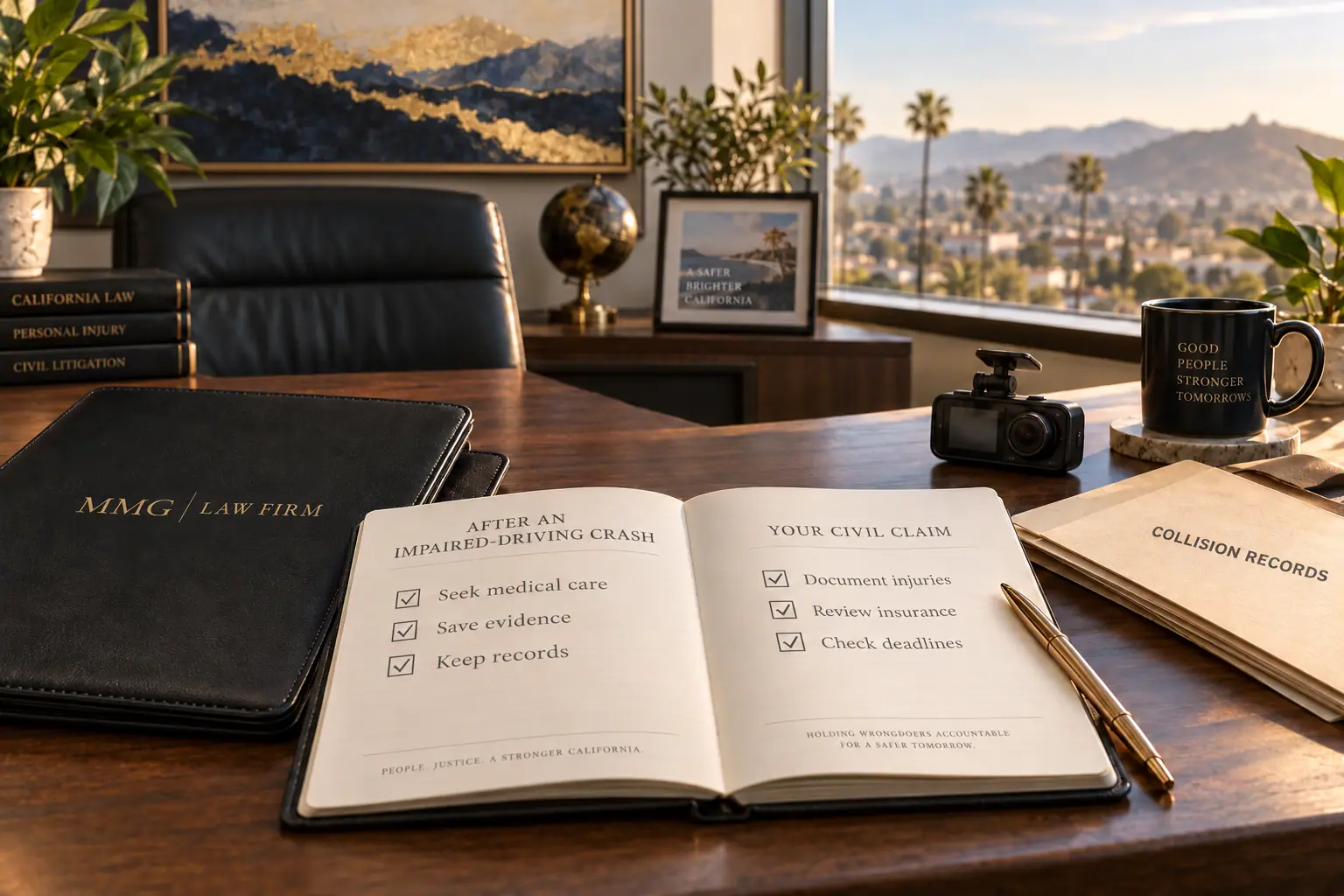

01
Preserve evidence
Keep records, photos, video, and witness details.

02
Document losses
Track medical care, work impact, and expenses.

03
Review recovery options
Explore insurance, restitution, and other sources.
A civil claim follows its own path.
Criminal proceedings and injury claims serve different purposes. Check civil deadlines early.

What happened before impact?
Preserve original video, witness details, and available records.

How did the crash affect you?
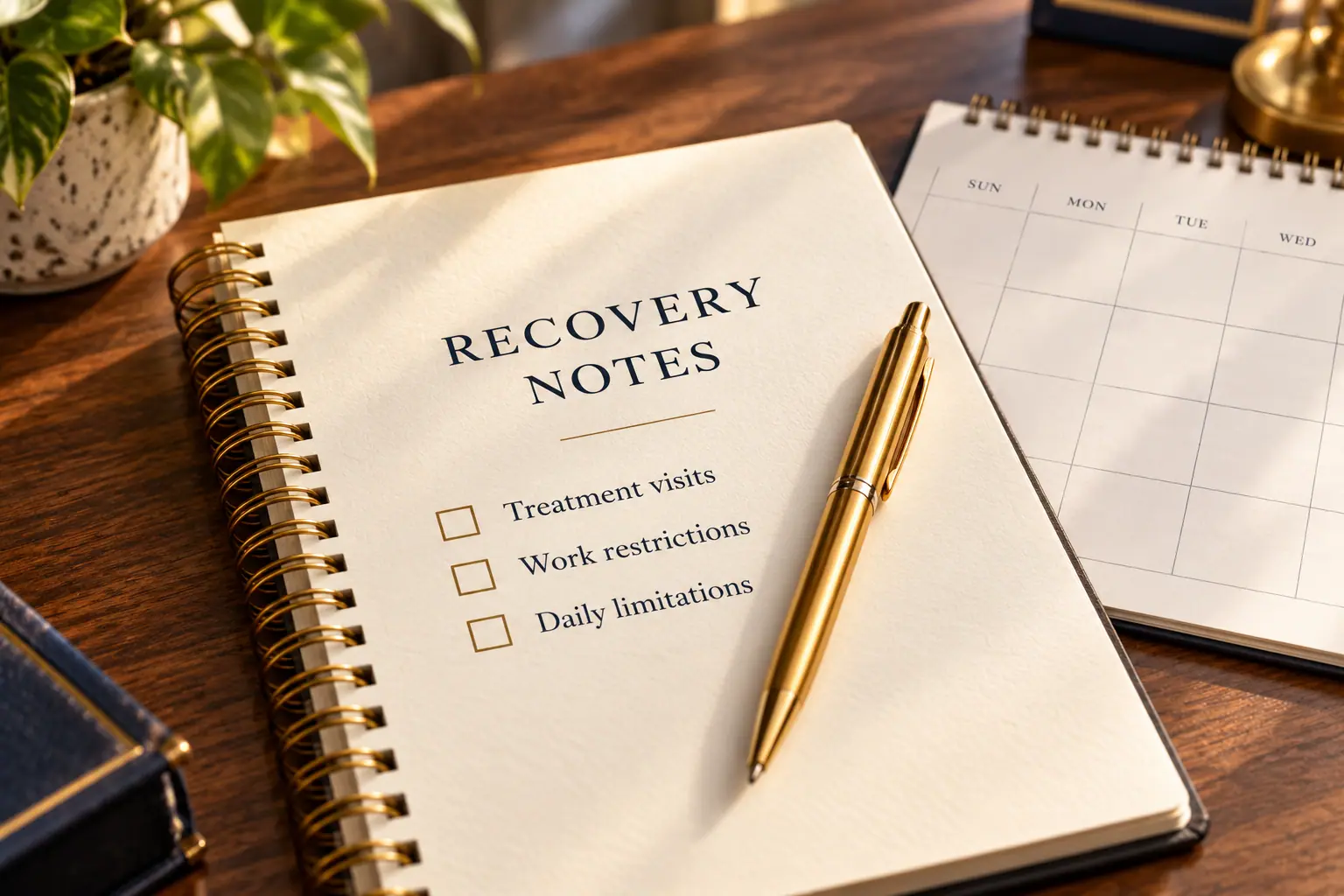
Document treatment, work restrictions, and daily limitations.
View details
Your recovery deserves a clear next step
After a crash involving a suspected impaired driver, you may face medical bills, missed work, insurance calls, and questions about a criminal investigation. A civil injury claim can address losses caused by another person’s wrongful conduct. It follows its own process, even when police and prosecutors are also involved.
MMG Law Firm helps people evaluate California accident claims from its Glendale office. An evaluation can address the evidence, available insurance, deadlines, and the effect of a proposed settlement.
Call (818) 539-7969 or request a free case evaluation. No recovery, no attorney fees or case expenses owed to MMG. Medical bills and other third-party obligations are separate.
What to do after a suspected impaired-driving crash
Prioritize safety and medical care. Call 911 for an emergency or an immediate danger. Tell responding officers what you actually observed; do not confront, follow, or attempt to test a driver yourself.
- Exchange driver, vehicle, and insurance information when safe.
- Keep the police agency’s name, report number, and any available criminal case information.
- Save original photographs and dashcam footage, including the period before and after impact.
- Obtain witness contact details and preserve their independent observations.
- Keep treatment records, work restrictions, receipts, and insurer correspondence.
- Notify your insurer as your policy requires and retain copies of communications.
California DMV requires an SR-1 within 10 days for a crash involving injury, death, or property damage over $1,000. This is separate from a police report. Review DMV accident-reporting instructions and what to do after a California accident.
A DUI arrest does not guarantee a civil payout.
Evidence, coverage, and legal requirements still matter. Punitive damages require additional proof.
A civil claim and a DUI prosecution are different
The criminal case
Prosecutors decide whether to pursue charges. Criminal proceedings address alleged offenses and may result in penalties and victim restitution. Your injury lawyer does not control charging decisions or guarantee a conviction.
The civil injury claim
A civil claim seeks compensation from legally responsible parties or applicable insurance. It must address responsibility, causation, and legally recoverable losses. The ordinary civil negligence burden differs from the criminal standard, and specific issues can carry different proof requirements.
An arrest alone does not prove every part of a civil claim. Conversely, the absence of an arrest or conviction does not automatically defeat one. The effect of a plea, conviction, dismissal, or other criminal ruling requires individual legal analysis.
Do not wait for a criminal case to finish before checking civil deadlines. Learn about California victims’ rights and how an accident claim works.
What must the evidence show?
The evidence must connect wrongful conduct to the collision and the injuries claimed. Impairment may be important, but it does not eliminate the need to investigate how the crash happened or document the resulting harm.
California’s Judicial Council instruction explains impairment by asking whether alcohol, drugs, or their combined effects impaired safe driving ability to an appreciable degree. Read CACI 709 on driving under the influence.
Drug-related impairment can involve prescription or over-the-counter medication as well as illegal drugs. A lawful prescription does not establish that a person was safe to drive. Equally, the presence of a substance does not by itself answer every question about impairment, timing, or causation. See the California DMV alcohol and drugs guide.
Records that may matter
Collision and impairment evidence
Depending on availability and lawful access, relevant material may include officer observations, witness accounts, video, chemical-test records, dispatch records, photographs, and vehicle information. Testing time, procedures, and interpretation may require qualified expert review. Do not assume that all investigation records are immediately available to you.
Describe observations rather than conclusions: what the vehicle did, what you heard, and what you saw. Preserve original files and correspondence. Footage can be overwritten, and evidence may become harder to obtain as time passes.
Injury and loss evidence
Medical records, diagnosis, treatment recommendations, income records, and documented limitations help explain the consequences of the collision. Give providers an accurate history, including relevant prior conditions. Keep factual notes about missed work and assistance you need, without exaggerating symptoms or guessing at future costs.
Serious injuries may require analysis of future care and reduced earning capacity. See catastrophic injuries, traumatic brain injury, and medical bills and treatment costs.
What compensation may be available?
Depending on the facts and applicable law, compensatory damages may include medical expenses, reasonably supported future care, lost earnings, reduced earning capacity, pain and suffering, and property losses. These categories are not automatic awards, and an impaired-driving allegation does not create a standard settlement amount.
Available insurance, fault disputes, evidence, and the responsible parties’ ability to pay affect the practical evaluation. The amount remaining for a client can also be reduced by fees, case expenses, and valid repayment obligations. Read compensation available after an accident.
If a family member died, different rules govern who may bring wrongful-death and related claims. See wrongful death after a vehicle accident for an introduction and seek an individual evaluation.
Are punitive damages available?
Punitive damages may be available in some cases, but they are not automatic after a DUI arrest or conviction. Civil Code section 3294 requires clear and convincing proof of oppression, fraud, or malice. An impaired-driving case may involve allegations of conscious disregard for others’ safety, but the specific facts and legal standard must be evaluated.
The California Supreme Court has recognized that qualifying intoxicated-driving conduct can support punitive damages. That does not mean every impaired-driving collision qualifies, or that an insurer will pay such an award. Coverage, legal restrictions, and collectability require separate review. Read Civil Code section 3294 and the Peterson decision discussing the Taylor rule, hosted by Stanford.
Could someone other than the driver be responsible?
Depending on the evidence, an investigation may examine vehicle ownership and permission, an employer’s connection to the trip, or negligent entrustment. Employment or ownership alone does not answer every liability question. Each theory has its own requirements.
Bars, restaurants, and social hosts
California generally limits civil liability for furnishing alcohol. It is not enough simply to show that a bar served an adult who later caused a crash. Narrow statutory exceptions can apply, including certain transactions involving an obviously intoxicated minor and an adult knowingly furnishing alcohol at the adult’s residence to someone the adult knew or should have known was under 21.
These exceptions have specific conditions and causation requirements. Preserve relevant facts and obtain advice rather than assuming that every alcohol provider can be sued. See Civil Code section 1714 and CACI 422 on alcohol provided to obviously intoxicated minors.
Restitution, victim assistance, and insurance
Criminal restitution
Victim restitution can address qualifying economic losses through the criminal proceeding. Keep records of expenses and payments, and ask the prosecutor’s victim-witness assistance office about the process. A restitution order does not guarantee immediate collection or necessarily address all damages potentially available in a civil case. The California Courts victim resources guide explains support and legal options.
California Victim Compensation Board
Eligible victims of qualifying crimes may receive help with specified expenses through CalVCB, subject to program rules and limits. It is not a replacement for all civil damages. Review eligibility and covered expenses.
Tell your lawyer about assistance received, restitution payments, and other reimbursements. CalVCB may have repayment rights and notification requirements when a lawsuit or insurance claim is filed. See its repayment guidance. Coordinate overlapping sources to avoid assuming the same expense can be collected twice.
Insurance options
Do not assume intoxication either guarantees or eliminates insurance coverage. Review the applicable policies and circumstances. If the at-fault driver’s insurance is insufficient or unavailable, uninsured or underinsured motorist coverage may provide options, subject to its requirements.
Before releasing a driver or accepting payment, review effects on other claims, coverage, and repayment obligations. See insurance settlement offers and releases.
Deadlines and working with MMG
California personal-injury lawsuits generally have a two-year deadline, but exceptions and shorter requirements can apply. Government claims often require an administrative claim within six months. Criminal proceedings and negotiations do not automatically pause civil deadlines. Review the California Courts personal-injury guide and California accident claim deadlines.
An MMG evaluation can identify records to preserve, potential recovery sources, approaching deadlines, and questions about the relationship between criminal and civil proceedings. If representation is agreed upon, the written agreement sets the scope and fee terms.
MMG advances case expenses without upfront payment. Contingency rates vary by case stage. No recovery means no attorney fees or case expenses owed to MMG; medical bills and other third-party obligations are separate. Read attorney fees and case costs.
Possibly. A civil claim depends on evidence of responsibility and harm, not solely an arrest. Driving conduct may support a negligence claim even where impairment cannot be established.
Your options require individual review. Your relationship to the driver does not by itself resolve the claim. Any argument about your own conduct must be evaluated under the applicable rules and evidence. See partial fault in California accidents.
No. The civil issues, available coverage, losses, and ability to collect still matter. Restitution and civil recovery should be coordinated, and no result can be promised.
Bring the crash date and location, report or case numbers, insurance letters, photos, and treatment information you have. Include restitution or victim-assistance paperwork. Do not send sensitive medical or financial details through a general website message; ask how to provide them securely.
CALIFORNIA
TOMORROW
STRONGER
Talk with MMG about your next step
Call (818) 539-7969 or request a free case evaluation. Phone and video consultations are available. Office visits at 100 W Broadway, Suite 540, Glendale, are by appointment.
Contacting MMG does not by itself establish an attorney-client relationship or extend a deadline. This page provides general California legal information, not advice about an individual case.
IN THIS GUIDE
Preserve the record.
Keep facts, documents, and original files.
Police and case information
Save agency names and report numbers.

Video and witnesses
Keep originals and independent accounts.
Medical and work records
Document treatment and restrictions.

Insurance and assistance
Keep letters and payment records.
An arrest alone does not establish every part of a civil claim.
UNDERSTAND THE DIFFERENCE
Two processes. Different purposes.
Both can be part of what happens after an impaired-driving crash.

Criminal proceedings
Prosecutors pursue alleged offenses. Restitution may address qualifying losses.

Civil injury claim
Seeks compensation based on responsibility, injury evidence, and available recovery sources.

Do not wait for the criminal case to finish before checking civil deadlines.

After an impaired-driving crash
Use this checklist to keep track of important information.