
Car Accidents · Rear-End Collision
Rear-End Accident Lawyer in California: Who's at Fault?
Rear-end crashes are California's most common collision — and the most commonly underpaid. Here's how fault, injuries, and claim value really work.
Mihran M. Ghazaryan··6 min read
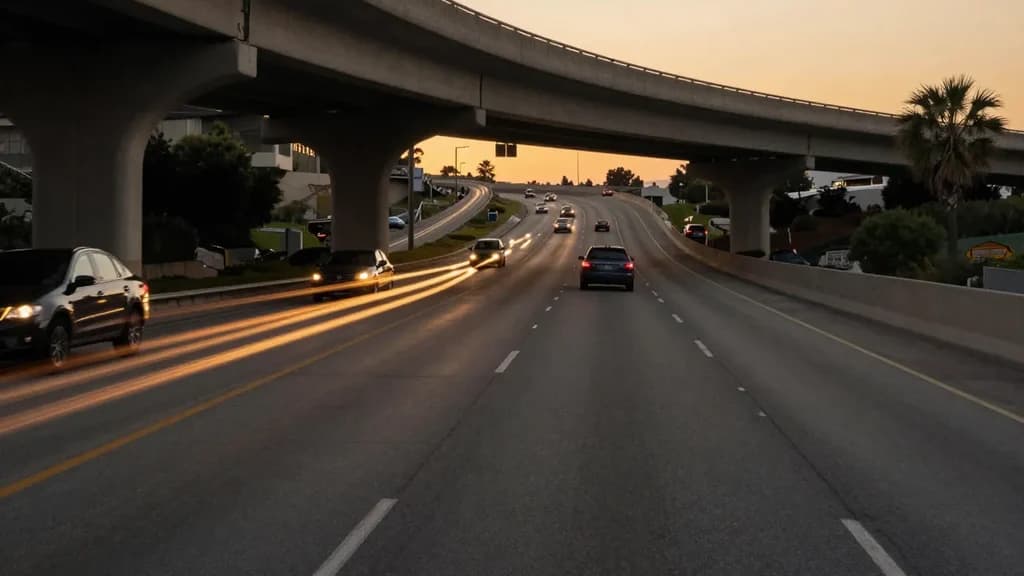
Traffic on the 405 stops without warning, and the driver behind you doesn't. It happens thousands of times a day in California — and the insurance company's first move is almost always to treat it as a minor claim.
Rear-end crashes are the most common type of collision on California roads, and they are also the most commonly underpaid. If you were hit from behind, here is how fault actually works under California law, what your claim is worth, and when it makes sense to talk to a rear-end accident lawyer.
Is the Rear Driver Always at Fault in California?
Not automatically — but usually. California has no statute that says "the back car is always liable." What it has is Vehicle Code § 21703, which prohibits following another vehicle "more closely than is reasonable and prudent," and Vehicle Code § 22350, the basic speed law requiring drivers to travel at a speed that is safe for conditions.
When a driver violates one of those sections and the violation causes the crash, California Evidence Code § 669 creates a rebuttable presumption of negligence. Practically, that means the burden shifts: the rear driver has to explain why they weren't careless. Most can't. A driver who leaves enough space and pays attention can stop for the car in front of them.
The presumption is rebuttable, though, and defense lawyers try. Situations where the front driver may share fault include:
- Brake checking or an abrupt, unnecessary stop to retaliate
- Non-functioning brake lights that gave no warning
- Reversing into the car behind, common in parking lots and driveways
- A cut-off — merging in front of another car with almost no gap
- Stopping in a live traffic lane without hazard lights after a breakdown
- Chain-reaction pileups, where the car behind you was pushed into you by a third vehicle
What Happens If You're Partly to Blame
California is a pure comparative negligence state, a rule established in Li v. Yellow Cab Co. (1975). Your compensation is reduced by your percentage of fault, but it is never eliminated. If a jury values your case at $100,000 and finds you 20% responsible because one brake light was out, you recover $80,000.
That matters because adjusters routinely inflate the injured person's share of blame to shrink a payout. Assigning fault is a factual fight, not a formality — how comparative negligence works in California explains the rule in more depth.
The Injuries Insurers Call "Minor"
Low property damage does not mean low injury. Modern bumpers absorb impact and hide crash forces; the human neck does not. Common rear-end injuries include:
- Whiplash and cervical strain — the head snaps forward and back, tearing soft tissue
- Herniated or bulging discs in the neck and lower back
- Concussion or mild traumatic brain injury, even without hitting your head
- Shoulder injuries from bracing against the wheel or seat-belt loading
- TMJ and jaw pain, frequently missed at the emergency room
Symptoms are often delayed 24 to 72 hours as adrenaline wears off and inflammation sets in. Get evaluated promptly anyway. A gap between the crash and your first medical visit is the single most common argument insurers use to discount a rear-end claim.
Steps to Take After Being Rear-Ended
At the scene: call 911 if anyone is hurt, photograph both vehicles from multiple angles including the license plates, and get the other driver's insurance information and the names of any witnesses.
Within 10 days: California requires you to file an SR-1 report with the DMV if anyone was injured or killed, or if property damage exceeded $1,000 — a threshold almost any modern collision clears. This obligation is separate from any police report and applies even if the police responded. Forms and instructions are at the California DMV.
In the following weeks: follow your treatment plan without long gaps, keep every bill and mileage record, and be careful with the other driver's adjuster. You are not required to give a recorded statement to the other driver's insurer, and doing so early — before anyone knows the full extent of your injuries — rarely helps you.
How Rear-End Claims Are Valued
There is no calculator that produces a real number, and any lawyer who quotes you a figure before reviewing your records is guessing. Valuation comes down to:
- Economic damages — medical bills incurred and reasonably expected in the future, lost wages, lost earning capacity, vehicle repair or total loss, and out-of-pocket costs
- Non-economic damages — pain, suffering, and loss of enjoyment of life, which scale with the severity and permanence of the injury, not with the dent in the bumper
- Insurance limits — California's minimum liability coverage rose on January 1, 2025 to $30,000 per person / $60,000 per accident / $15,000 property damage. When injuries exceed the at-fault driver's limits, your own uninsured and underinsured motorist coverage often becomes the real source of recovery.
One important caveat: under Civil Code § 3333.4 (Proposition 213), a driver who was uninsured at the time of the crash generally cannot recover non-economic damages, even when the other driver was entirely at fault.
Deadlines You Cannot Miss
Under Code of Civil Procedure § 335.1, you generally have two years from the date of the crash to file a personal injury lawsuit in California. Property damage claims carry a three-year deadline. If the at-fault driver was working for a city, county, transit agency, or the state, you must first file an administrative claim — usually within six months — before you can sue at all.
Deadlines vary with the facts, including claims involving minors, and missing one ends the claim permanently. If you are unsure which applies, confirm it early; the California Courts self-help center is a useful starting point, but an evaluation of your specific situation is better.
Frequently Asked Questions
Should I get a lawyer for a rear-end accident?
If you were treated and released with no ongoing symptoms and the property damage is small, you may not need one. If you are still in pain after a few weeks, missed work, were referred for imaging or injections, or the adjuster is disputing fault or pushing a quick check, an attorney evaluation is worth the call. Consultations are free.
How much is a rear-end accident claim worth?
It depends on the injuries, the treatment required, wage loss, and available insurance limits — realistic outcomes range widely, from a few thousand dollars for a fully resolved soft-tissue strain to substantially more for a disc injury requiring surgery. Be skeptical of any specific promise made before your medical records exist.
How long does it take to settle a rear-end case?
Most claims resolve in several months to a year. The main driver is medical treatment: a claim generally should not settle until you reach maximum medical improvement, because you cannot reopen it later. Litigation adds time. We break the stages down in our guide to the California car accident settlement timeline.
The other driver's insurer offered me money the next day. Should I take it?
Almost never. Early offers arrive before anyone knows whether your symptoms will resolve, and accepting one requires signing a release that closes the claim forever — including future treatment for the same injury.
What if the driver who hit me had no insurance?
Your own uninsured motorist coverage steps in, if you carry it. It is optional in California but inexpensive, and it is the reason many hit-from-behind claims get paid at all.
Talk to a California Rear-End Accident Attorney
Being rear-ended is not a "minor" case just because the insurance company files it that way. At MMG Law Firm, we handle car accident claims for injured people across California on a contingency fee — you pay nothing up front, and no fee unless we win. The consultation is free and carries no obligation. Contact us to have someone review the facts of your crash and tell you honestly where you stand.