
construction accident · personal injury
Construction Accident Lawyer California: Can You Sue?
Workers' comp is not always the end of the road. If a third party contributed to your jobsite injury, California law lets you bring a separate claim.
Mihran M. Ghazaryan··6 min read
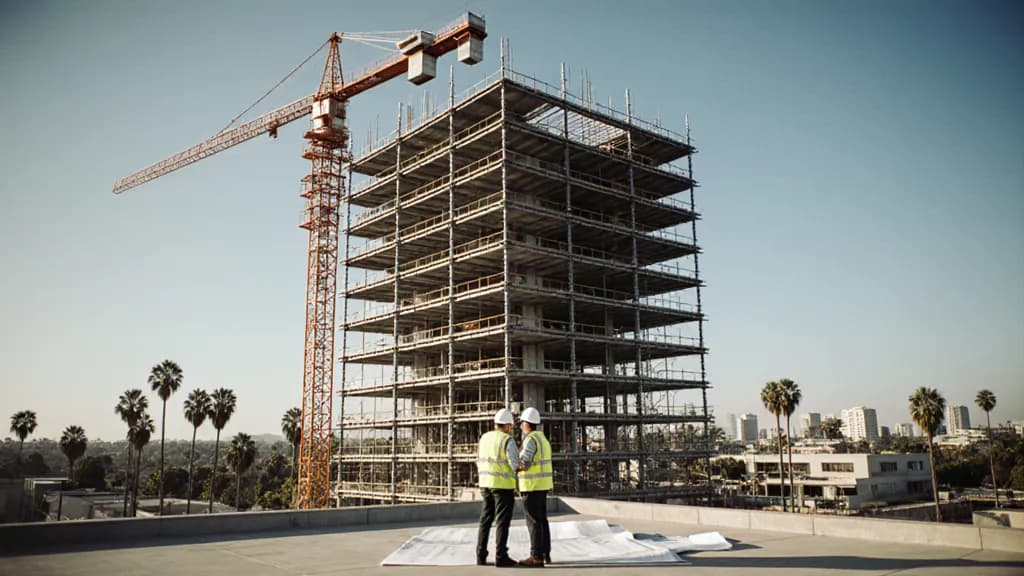
A fall from a scaffold, a trench collapse, a load dropped from a crane — construction sites produce some of the most severe injuries in California, and also some of the most confusing claims. Most injured workers are told "you have workers' comp, that's it." That is often wrong.
Workers' compensation is only one piece. If someone other than your employer contributed to the accident — a general contractor, a subcontractor, a property owner, an equipment manufacturer, a delivery driver — California law lets you bring a separate third-party personal injury claim on top of your comp benefits. That second claim is where pain and suffering, full lost earnings, and meaningful compensation usually come from.
Workers' Comp vs. a Third-Party Claim
California's workers' compensation system is a trade-off written into Labor Code § 3600. You get benefits without proving anyone was at fault. In exchange, you generally cannot sue your own employer for negligence — that is the "exclusive remedy" rule.
But the exclusive remedy protects your employer only. It does not shield anyone else on the jobsite. Labor Code § 3852 expressly preserves your right to sue a negligent third party, and you can pursue both claims at the same time.
The practical difference is large:
- Workers' comp pays medical treatment, temporary and permanent disability benefits, and a supplemental job displacement voucher.
- Workers' comp does not pay anything for pain and suffering, loss of enjoyment of life, or the full value of your future earning capacity.
- A third-party claim can recover all of those, plus past and future medical costs and household services.
If your employer's comp carrier paid benefits, it will typically assert a lien against your third-party recovery (Labor Code § 3856). That lien is frequently negotiated down, and how it is handled can change your net recovery substantially.
Who Can Actually Be Held Liable
Construction sites are layered with separate companies, which is exactly why a construction injury lawyer starts by mapping who controlled what. Common third-party defendants include:
- General contractors who retained control over safety and exercised it badly.
- Other subcontractors whose crew created the hazard — an unguarded floor opening, an unsecured load, a live circuit.
- Property owners who knew about a concealed dangerous condition and did not disclose it.
- Equipment and material manufacturers, through a product liability claim for a defective lift, ladder, saw, or safety harness.
- Drivers who struck a worker in a work zone — a claim handled like any other vehicle case.
- Engineers and architects whose design or specification created the danger.
The Privette Doctrine — and Its Exceptions
If you work for a subcontractor, expect the general contractor to cite Privette v. Superior Court (1993). Under Privette and later cases, a company that hires an independent contractor is presumed to have delegated jobsite safety to that contractor.
The presumption is rebuttable, and the exceptions matter:
- Retained control — the hirer kept control over some part of the work and affirmatively contributed to the injury (Hooker v. Department of Transportation; refined in Sandoval v. Qualcomm, 2021).
- Concealed hazard — the landowner knew of a hidden danger on the premises that the contractor could not reasonably have discovered (Kinsman v. Unocal).
Proving retained control usually turns on documents most workers never see: safety plans, daily logs, toolbox talk sign-ins, subcontract terms, and text messages directing the crew. Those records get overwritten or lost quickly, which is a real reason not to wait.
Can You Ever Sue Your Own Employer?
Sometimes. California recognizes narrow exceptions to the exclusive remedy rule, including:
- Power press injuries where the employer removed or failed to install a required point-of-operation guard (Labor Code § 4558).
- Fraudulent concealment of a known injury that aggravated it (Labor Code § 3602(b)(2)).
- Willful physical assault by the employer (Labor Code § 3602(b)(1)).
- Uninsured employers — if your employer illegally carried no comp coverage, you may sue in civil court, and negligence is presumed (Labor Code § 3706 and § 3708).
These are fact-specific and frequently contested. Do not assume one applies, and do not assume none does.
How Cal/OSHA Findings Fit In
A Cal/OSHA investigation is separate from your claim — it can cite and fine a company, but it does not pay you. It can still be useful. Under Labor Code § 6304.5, Cal/OSHA safety orders are admissible in a third-party civil action to the same extent as any other statute or regulation, which means a violated Title 8 standard can help establish negligence. Investigation files, citations, and photographs obtained through Cal/OSHA often become core evidence. You can review the agency's standards and reporting process through the California Division of Occupational Safety and Health, and workers' compensation procedures through the Division of Workers' Compensation.
Deadlines You Cannot Miss
Two different clocks run at the same time, and they are not the same length:
- Third-party personal injury lawsuit: generally two years from the date of injury (Code of Civil Procedure § 335.1). More on how this works in our guide to the California personal injury statute of limitations.
- Claim against a public entity — a city, county, Caltrans, a school district, a transit agency: you must file a written government claim within six months of the injury before you can sue.
- Workers' compensation: report the injury to your employer promptly (within 30 days) and file the claim form; a formal application generally must be filed within one year.
Exceptions and tolling rules exist, and a few situations shorten these further. Have your specific dates reviewed rather than relying on a general rule.
What These Cases Are Worth
There is no formula, and anyone promising a number before reviewing records is guessing. Value is driven by the severity and permanence of the injury, the medical care required going forward, how much earning capacity was lost, the strength of the liability evidence, the available insurance limits across multiple defendants, and the comp lien. Catastrophic outcomes — spinal cord injury, amputation, severe burns, traumatic brain injury — carry the largest lifetime care and wage-loss components, which is where careful documentation matters most.
Frequently Asked Questions
Can I file a lawsuit if I already accepted workers' comp benefits?
Yes. Accepting comp benefits does not waive a third-party claim. The two proceed in parallel, and the comp carrier is reimbursed out of any third-party recovery.
Does my immigration status affect my claim?
California law provides that all protections and remedies available under state law apply regardless of immigration status (Labor Code § 1171.5, Civil Code § 3339), and a person's immigration status is generally not discoverable or admissible in a personal injury action. Injured undocumented workers can and do recover.
What if I was partly at fault for the accident?
California uses pure comparative fault. Your recovery is reduced by your percentage of responsibility but is not eliminated, even if you were mostly at fault. Insurers routinely overstate a worker's share — that assignment is negotiable and, ultimately, a jury question.
What should I do right after a construction accident?
Report the injury to your employer in writing, get medical treatment and follow through with it, photograph the scene and the equipment involved if you safely can, write down the names and employers of every witness, and keep your own copy of everything. Avoid giving a recorded statement to any insurer other than your own before getting advice.
How much does a construction accident lawyer cost?
Personal injury cases are handled on contingency — no fee unless there is a recovery — so an initial case review costs nothing out of pocket.
If you or a family member was hurt on a California jobsite, a short conversation can tell you whether a third-party claim exists alongside your workers' compensation case. We offer a free, no-obligation consultation, we work on contingency for injury cases — no fee unless we win — and we represent clients across California. Contact us to have your situation reviewed while the jobsite evidence is still available.